BRN Discussion Ongoing

stockduck

Regular
Just a thought...a little bit offtopic:

I recently went to the hairdresser, as most of us do a few times a year. The former master hairdresser has handed over his business to the younger generation, but still works enthusiastically. Here's the problem, which I believe could lead to a new product with high global sales.

The hands, with their bones, tendons and muscles, are subject to severe wear and tear in the hairdressing trade, which could be reduced by a precise, effective and efficient high-performance exoskeleton. I would suggest that it makes more sense to develop such products equipped with intelligent sensors than robots for domestic use. Mass-produced goods made of injection-moulded plastic parts and weighing very little.

In gardening, electronic shears are used as a substitute for manual labour, but in my opinion, this cannot be transferred to hairdressing.

Perhaps the management knows a customer, who is interested in such a product and sees a future for it. (One battery change per working day, for example).

It is likely that such an exoskeleton could also be extended to other professions.


Translated with DeepL.com (free version)
 

stockduck

Regular
...only dot joining....:cry:


New fuel gauge solution delivers State‑of‑Health reporting, adaptive battery modeling, and seamless fleet observability via nRF Cloud powered by Memfault.​


.


....
The nRF54LS05A and nRF54LS05B combine a 128 MHz Arm® Cortex® M33 with low-leakage RAM for efficient, responsive processing in compact, ultra-low-power wireless designs.....
 
Last edited:
  • Fire
  • Like
Reactions: 2 users

Frangipani

Top 20
James Shields (our VP of Sales & Business Development) and Ivan Projić (CEO of Neuromorphyx) at the BrainChip booth at embedded world 2026 earlier today:


6A0AEF2B-328F-4DE4-9C78-1376F9A7AEF0.jpeg


D5663276-DDB7-4A74-8532-C36F38B431EE.jpeg
 
Last edited:
  • Like
  • Love
  • Fire
Reactions: 19 users

Frangipani

Top 20
As suspected, the recent article 👆🏻 that claimed BrainChip “had secured an order from Nex Novus for medical sensing applications” was wrong:

There will be a live demo of the made-in-Croatia Neuromorphyx Vision NeuroNode at the BrainChip booth at Embedded World 2026 in Nürnberg (10—12 March).

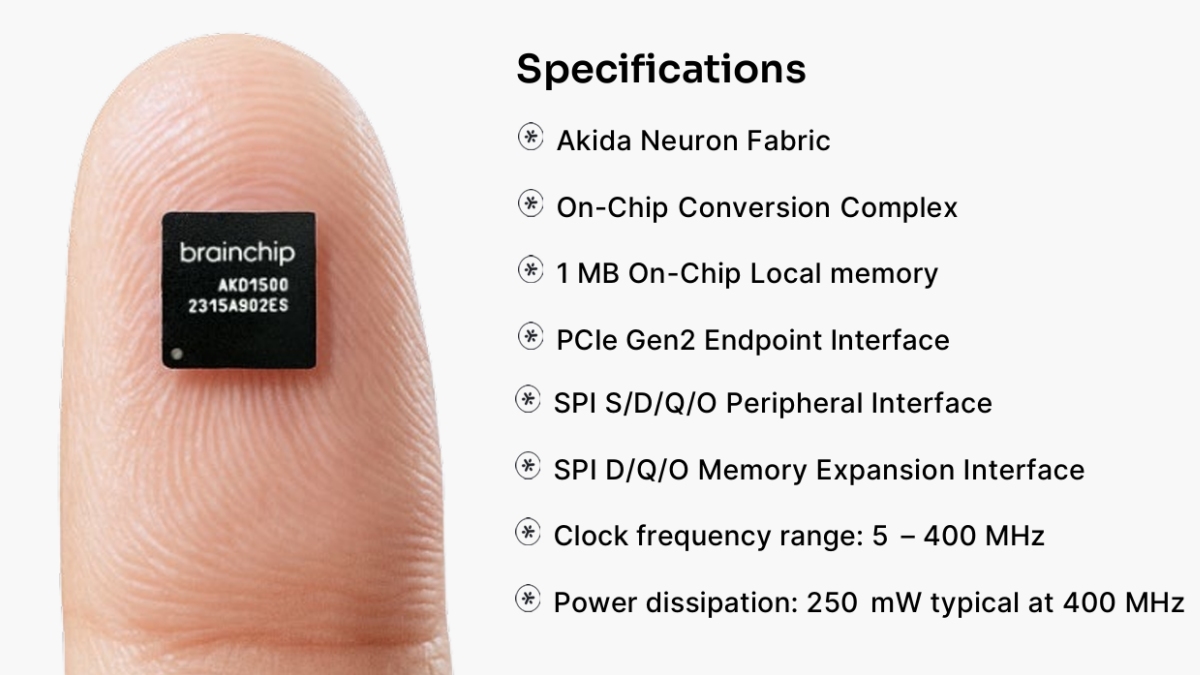
“Experience the Vision NeuroNode™ tiny, compact and rugged form in-person! Featuring the AKD1500 neuromorphic co-processor from Brainchip Inc. pushing the boundaries of high-performance, low-latency, Spiking Neural Networks (SNN) for energy efficient edge AI.

POWER & COMPUTE EFFICIENCY < 300 mW while delivering 800 GOPS

ON-CHIP LOCAL MEMORY 1 MB
CLOCK FREQUENCY RANGE 5 – 400 MHz
SILICON PROCESS 22 nm FD-SOI CMOS digital logic
PACKAGE 7×7 mm MFCTFBGA169, 0.5 mm pitch

Find us at:
Hall 5 / Booth 5-213 (10 - 12 March 2026. Nuremberg, Germany)

NeuroNode™​

Deployment time - seconds.
Operational lifetime - years.
Scalability factor - unparalleled.

Rugged build.
Always-on sensing.
Energy-efficient processing.
Battery-powered operation.
Low-latency reactions.

The Vision NeuroNode™ is armed with an FPGA, a neuromorphic AI accelerator and an event-based neuromorphic vision sensor.
Our IP and architecture, allows up to multiple-years* of field operation on a single battery pack integrated in our compact 5x5x5cm IP67 case.

*Depending on scene activity and inference.

We offer solar panels and add-on battery packs as attachments that further prolong the operational life-time and extend capabilities.

  • Fast tracking, equivalent to >10.000 FPS
  • Extreme lightning conditions >120dB
  • Native power efficiency <10mW
Technology developed by Prophesee and Sony.
Skillfully engineered into compact modules by CenturyArks.
We offer a wide range of sensors and lenses to meet our client requirements depending on deployment location, terrain and field conditions.
HD 1280 x 720 Sony IMX636 / IMX646 (via CenturyArks)
VGA 640 x 512 Sony IMX 637 / 647 (via CenturyArks)
320 x 320 ultra low-power GENX320 (via Prophesee)
Explore sensor features in the Sensor options section →

[…]

NeuroHive™​

Vision, Audio, Radar, IMU are different NeuroNodes™ forming the hive mind network. Distributed intelligence, at the edge.

NeuroHive™ provides your team with the ability to gather mission critical intel from the field, live. Scalable and reliable.


Over-the-air SNN model switching.
Tracking target velocity and direction.
Fleet management.
Orchestrated systems.
External API triggers.
Integration to existing systems and comms.”


View attachment 95475 View attachment 95476 View attachment 95477 View attachment 95478 View attachment 95479 View attachment 95480 View attachment 95481 View attachment 95483
View attachment 95482

Here is today’s official press release:


Mar 5, 2026 9:00 AM Eastern Standard Time

BrainChip Announces Neuromorphyx as Strategic Customer and Go-to-Market Partner for AKD1500 Neuromorphic Processor​


LAGUNA HILLS, Calif.--(BUSINESS WIRE)--BrainChip Holdings Ltd (ASX: BRN, OTCQX: BRCHF, ADR: BCHPY), the world leader in ultra-low power, fully digital, event-based neuromorphic AI, today announced that Nex Novus d.o.o., Neuromorphyx™ has selected the Akida™ AKD1500 co-processor for evaluation and integration in its Vision NeuroNode™ edge-AI device.


This strategic engagement and partnership agreement expands BrainChip’s reach into defense, robotics and industrial edge sensing. By integrating the AKD1500 into Neuromorphyx’s rugged, modular architecture, the companies are enabling always-on intelligence where power, bandwidth and connectivity are constrained.

Enabling Scalable, Always-on Edge Intelligence
The AKD1500 will be integrated into Neuromorphyx’s modular NeuroBlocks™ architecture: SensorBlock™ (DVS/EVS), BridgeBlock™ (FPGA), BrainBlock™ (AKD1500) and InterfaceBlock™, forming a key compute element within the Vision NeuroNode™ device and its NeuroHive™ fleet orchestration platform. By leveraging BrainChip’s Akida™ technology, Neuromorphyx is building configurable edge nodes for real-time detection and tracking using event-based vision and other sensors such as audio, radar and IMU:
  • Ultra-low power, always-on inference: AKD1500 supports mission-critical detection pipelines within tight power budgets, operating at milliwatt power levels (under 300mW for high-performance tasks), enabling battery deployments matching the core NeuroNode feature of multi-year field operations on a single integrated battery.
  • Low-latency sparse processing: Paired with event-based vision sensors, NeuroNode™ can convert event streams into compact spatiotemporal tensors and run them on AKD1500, where Akida’s event-based execution exploits activation sparsity to reduce data movement and accelerate response.
  • Configurable deployment at scale: AKD1500’s 1 MB on-chip memory enables NeuroNode™ to run fully self-contained neuromorphic SNN models without external DRAM, reducing power, latency, and attack surface while enabling deterministic real-time response.

The Potential: Networked NeuroNodes at Scale

Neuromorphyx’s approach to in-house manufacturing scalability paired with AKD1500 competitive pricing, allows for compact NeuroNodes to have simple deployments even in tens of thousands of units by forming networks that cover vast areas managed with NeuroHive™: a map-based platform for deploying, monitoring and updating these edge nodes across sites. T
he platform supports coordinated sensing, target analytics (including velocity and direction), and external API triggers for integration into existing command-and-control or industrial systems, while natively maintaining privacy and keeping processing at the edge.

"Our mission has always been to bring AI to the edge where it is most needed," said Sean Hehir, CEO of BrainChip. "Neuromorphyx is building a compelling, modular platform for deploying always-on intelligence in demanding environments. By combining event-driven sensing with Akida’s ultra-low power neuromorphic processing, we’re helping enable scalable edge AI for defense, industrial monitoring and autonomous systems."

About Neuromorphyx™ and Nex Novus d.o.o.
Neuromorphyx™ is a deep-tech hardware and embedded software company, spun out of Nex Novus d.o.o., focused on high-performance, energy-efficient edge AI for defense, robotics and industrial sensing. Its modular NeuroBlocks™ architecture enables configurable edge AI devices, NeuroNodes™, built around advanced sensors, including event-based vision, audio, radar, IMU and a choice of accelerator technologies. Neuromorphyx’s NeuroHive™ platform provides fleet management, orchestration and secure over-the-air model updates.

About BrainChip Holdings Ltd (ASX: BRN, OTCQX: BRCHF, ADR: BCHPY):
BrainChip is the worldwide leader in Edge AI on-chip processing and learning. The company’s first-to-market, fully digital, event-based AI processor, Akida™, uses neuromorphic principles to mimic the human brain, analyzing only essential sensor inputs with unmatched efficiency and energy economy. Explore more at www.brainchip.com.

Contacts​

Media Contact
Madeline Coe
prforbrainchip@bospar.com
224-433-9056

Some more info provided by Neuromorphyx in the above video and below comment about the nature of potential customers they have in mind:


4F09A0CB-A892-4A94-A3B7-D47B4A065B23.jpeg
 
  • Like
  • Love
  • Fire
Reactions: 12 users

stockduck

Regular

....

Availability:​

The reference platform is licensed to accelerate development for OEMs and system integrators; including hardware schematics, firmware, and a companion mobile application. It will be available for evaluation in May 2026, with volume in Q3 2026.
.....
 
  • Like
  • Fire
Reactions: 6 users

Frangipani

Top 20
Just a thought...a little bit offtopic:

I recently went to the hairdresser, as most of us do a few times a year. The former master hairdresser has handed over his business to the younger generation, but still works enthusiastically. Here's the problem, which I believe could lead to a new product with high global sales.

The hands, with their bones, tendons and muscles, are subject to severe wear and tear in the hairdressing trade, which could be reduced by a precise, effective and efficient high-performance exoskeleton. I would suggest that it makes more sense to develop such products equipped with intelligent sensors than robots for domestic use. Mass-produced goods made of injection-moulded plastic parts and weighing very little.

In gardening, electronic shears are used as a substitute for manual labour, but in my opinion, this cannot be transferred to hairdressing.

Perhaps the management knows a customer, who is interested in such a product and sees a future for it. (One battery change per working day, for example).

It is likely that such an exoskeleton could also be extended to other professions.


Translated with DeepL.com (free version)

You will find that there are already exoskeletons available adapted to the needs of hairdressers (and many other professions), although they don’t support their hands as such (which I assume would be difficult, as the job requires nimble fingers), but help to reduce fatigue and relieve pain, typically in the arms, shoulders, neck, and upper back. This in turn of course benefits the hands as well.


Also check out SuitX by Ottobock for exoskeletons in general - some motorised, others not:

https://www.suitx.com/de/startseite

One of their use cases: IKEA


IMO definitely a future market for neuromorphic technology.
 
  • Fire
  • Like
  • Love
Reactions: 4 users

Frangipani

Top 20


841DDD1E-F5A9-47E1-8A46-61C318CB0DF7.jpeg
 
  • Like
  • Fire
Reactions: 6 users
What the actual FK is going on here.
Now we're relying for some random IBM guy making music for our revenue? FFS
Can we just vote these clowns out for not meeting they performance targets!!
Wish we could just vote a few clowns out from here, mention no names 😂
 
  • Haha
  • Like
Reactions: 5 users

Frangipani

Top 20
Linas BeliūnasLinas Beliūnas • 3rd+Premium • 3rd+Building a Safer Internet with AI 🤖 | Scouting for top startups to invest in 💸 | The only newsletter you need for Finance & Tech at 🔔linas.substack.com🔔 | Financial Technology | FinTech | Artificial Intelligence | VCBuilding a Safer Internet with AI 🤖 | Scouting for top startups to invest in 💸 | The only newsletter you need for Finance & Tech at 🔔linas.substack.com🔔 | Financial Technology | FinTech | Artificial Intelligence | VC
Visit my website
1d • Edited • 1 day ago • Edited • Visible to anyone on or off LinkedIn
Follow

Wild: Scientists just built a biological computer that runs DOOM using living neurons. No AI model was involved, and the entire system fits in a shoebox 😳

Australian startup Cortical Labs just showed a system where ~200,000 lab-grown human neurons control the classic shooter Doom.

No code runs inside the cells.
No gradient descent.
No training dataset.

Just biology learning 🧠

The setup is almost surreal:

→ A shoebox-sized biological computer called CL1 keeps neurons alive with nutrients, temperature control, and waste removal.
→ Game information is sent as electrical signals directly to the cells.
→ The neurons’ spikes are decoded into game actions: move, turn, shoot.
→ The culture learns during the session, adapting to threats and navigation.

This builds on their earlier DishBrain experiment that learned to play Pong.

But Doom is different.

Now you need 3D movement, aiming, and threat detection - all handled by a tiny living network.

And the energy numbers are wild:

↳ A rack of ~30 CL1 units runs on under 1 kW
↳ That’s orders of magnitude less power than comparable silicon AI workloads

Which means that ontelligence may not require massive GPU clusters.

It might emerge from physics + feedback.

Silicon gives us speed.
Biology gives us efficiency and plasticity.

The interesting future might be hybrid systems - chips doing math, neurons doing adaptation.

And if we can grow intelligence, we may soon need to rethink what actually counts as a computer…

P.S. also check out how to Turn Claude Cowork Into Your Personal COO that does the work while you sleep 🧠: https://lnkd.in/eS6JCk2G


Play
Loaded: 100.00%


Remaining time 0:01
1x
Playback speed
Unmute

Turn fullscreen on

  • like
    insightful
    celebrate
    1,093
    • 263 comments
    • 184 reposts

Reactions​

Like
Comment

Repost


Send


Add a comment…
Open Emoji Keyboard


Current selected sort order is Most relevantMost relevant

View Peter Van Der Made’s  graphic link

Peter Van Der Made • Following

Founder and Director at BrainChip Holdings Limited
1h


I think the same could be true for the Akida 1500 neuromorphic network. In its native mode it learns from spiking input and it has more neurons.


Like
like
9

Reply2 replies2 Replies on Peter Van Der Made’s comment

See previous replies

View Kevin D. Johnson’s  graphic link

Kevin D. Johnson • Following

Field CTO – HPC, AI, LLM & Quantum Computing | Principal HPC Cloud Technical Specialist at IBM | Symphony • GPFS • LSF
1h


Peter Van Der Made Now that would make for a cool demo!


Like
like
1

Reply


0D255ED8-2643-4901-8EED-0D5AD2DB4832.jpeg
 
  • Like
  • Fire
  • Wow
Reactions: 12 users

Boab

I wish I could paint like Vincent
  • Fire
Reactions: 2 users

Frangipani

Top 20
Today’s post by femtoAI (formerly known as Femtosense) is a reminder that
1. AFRL is engaged with several neuromorphic players…
2. our customers - Neuromorphyx in this particular case - are also keenly watching what our competitors in the edge space are doing…


46E5DD95-D4DB-488D-B253-7B342B438909.jpeg


TRL = Technology Readiness Level
CRL = Commercial Readiness Level


83DC517B-4A01-4323-BEE3-F0D3595435BD.jpeg


Top Bottom