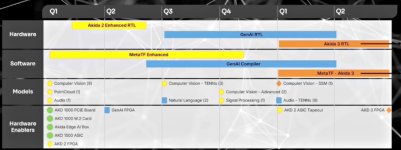
This announcement from back then, will be our personal “pyramids of Giza” thing…it’s there… everyone can see it…… but no one knows why its existing…If this is true, the market will price this in way before 2028-2030.... Hold on to your seats guys


This announcement from back then, will be our personal “pyramids of Giza” thing…it’s there… everyone can see it…… but no one knows why its existing…If this is true, the market will price this in way before 2028-2030.... Hold on to your seats guys
Hi Dio, you have raised the point that was bugging me as well, if we see the technology roadmap presso by JT , it clearly mentions Akida 2asic tapeout in Q1 2026. This year should see us with 2 products readily available 1500 and also Akida 2.Something which had slipped under my radar (if you'll pardon the expression) - the USAFRL/RTX micro-Doppler SBIR project is intended to use Akida 2/TENNs, following RTX's in-house tests with Akida 1 CotS. As the AKIDA 2 ASIC does not exist at the moment, the project may have used the FPGA version. If memory serves, the FPGA is 8 times slower than the ASIC. Despite this, there is the intention to produce the commercial version for see-in-the-dark radar.
Wait til they get the Akida 2 SoC ASIC.
https://www.defenceconnect.com.au/i...n-contract-with-air-force-research-laboratory
BrainChip engaged under US$1.8m contract with Air Force Research Laboratory
Industry
11 December 2024
BrainChip will partner with subcontractor(s) to develop comprehensive set of algorithms and neural networks optimised for BrainChip neuromorphic hardware.
The contract, granted under the US federal government’s Small Business Innovation Research (SBIR) program over the 12-month term of the agreement, is expected to develop neuromorphic radar signalling processing.
The SBIR contract award, under the topic number AF242-D015, is titled “Mapping Complex Sensor Signal Processing Algorithms onto Neuromorphic Chips”.
“Radar signalling processing will be implemented on multiple mobile platforms, so minimising system SWaP-C is critical,” said Sean Hehir, CEO of BrainChip.
“This partnership to improve radar signalling applications for AFRL showcases how neuromorphic computing can achieve significant benefits of low-power, high-performance compute in the most mission-critical use cases. This award is a very strong endorsement from leading organisations such as Air Force Research Laboratory for our industry-leading TENNs offering.”
The contract is an expansion of efforts after a multinational aerospace and defense customer successfully demonstrated radar processing algorithms capable of running on BrainChip’s commercial off-the-shelf neuromorphic hardware as part of an internal research and development initiative.
This current program, however, will develop algorithms based on BrainChip’s proprietary state space model algorithm framework known as TENNs (Temporal Event Neural Network) and will be optimised to run on Akida 2.0 hardware.
The BrainChip TENNs algorithm, combined with Akida 2.0 technology, has successfully demonstrated the capability to run models very efficiently, resulting in significantly higher performance at ultra-low power relative to traditional accelerators running traditional models.
BrainChip’s neuromorphic technology improves the cognitive communication capabilities on size, weight, power and cost-constrained platforms such as military, spacecraft and robotics for commercial and government markets.
The project focuses on a specific type of radar processing known as micro-Doppler signature analysis, which offers unprecedented activity discrimination capabilities. BrainChip is currently in negotiations to enter into a subcontractor agreement with the previously mentioned aerospace and defence company for the completion of the contract award.
BrainChip will partner with the subcontractor to provide research and development services developing and optimising algorithms for a fixed fee totalling $800,000 over the same period.
No other material conditions exist that must be satisfied for the agreement to become legally binding and to proceed. Air Force Research Laboratory will begin making milestone payments in January 2025.
Periodic payments will continue throughout the year concluding in February of 2026.
At the 9 minute mark in the roadmap Jonathan Tapson mentions that AKIDA 2 is available as an FPGA;
https://brainchip.com/brainchip-technology-roadmap/
@ 23 minutes - Akida 3 FPGA Q1 2026!
Akida 3 is more versatile than Akida 1 or 2 which use state machine architecture, whereas GenAI & Akida 3 use instruction set architecture which makes the architecture much more flexible.
Now that the Roadmap is about 8 months old, I found it encouraging to review the video. A few things that were a year out are now just over the next hill. It is packed with groundbreaking advances.

INTEL does not have the equivalent of AKIDA cloud which speeds up time to prototype.
 Join the INRC.
FF
From Edge Impulse a Qualcomm Company:
"Brainchip Akida represents the state of the art in production-ready Neuromorphic computing
, ideally suited to edge use-cases. We will be demonstrating the power of the Brainchip Akida in an industrial setting in this guide as part of a standalone inspection system that can be setup along a production line…
Edge Impulse and Brainchip
For an industrial automation engineer, or anyone not familiar with deep learning, this can seem daunting and slows down the efficacy of deploying AI-based inspection systems. The fastest path to market in the past has been expensive proprietary camera hardware and software solutions that abstract the process with complicated licensing, and limited access to the underlying platform. However, the Brainchip Akida acts as a co-processor, enabling you to use your existing x86 or Arm-based platform to have full freedom on your final application..."
https://docs.edgeimpulse.com/projects/expert-network/brainchip-akida-industrial-inspection
Wth is BCIA?... Gosh... written by AI...
 brainchip.com
brainchip.com
brainchip.com
In September, I shared a LinkedIn postby Adam Taylor, Founder and Lead Consultant of Adiuvo Engineering as well as Owner & Organiser of FPGA Horizons, about ORA:
“ORA is a comprehensive sandbox platform for edge AI deployment and benchmarking. Our catalogue of edge devices lets you test and evaluate which hardware best suits your application needs. With devices spanning Nvidia, Axelera, Hailo, and BrainChip, ORA offers diverse computing architectures. These range from traditional GPUs to cutting-edge neuromorphic processors and specialised AI accelerators. All accessible via a single interface.”
Turns out Adam Taylor recently co-founded Dublin-based space tech startup Setanta Space Systems (of which he is CEO), with fellow co-founders James Murphy (CTO) and Jake O’Brien (Lead Engineer), both of whom used to work for another space tech company based in the Irish capital: Réaltra Space Systems Engineering, which “is dedicated to the design, development and manufacture of cost-effective space electronic systems using cutting-edge technologies.” (https://www.linkedin.com/company/realtra/about/)
Setanta Space is “developing edge AI for space applications”:

Something I have been working on with James Murphy and Jake O'Brien for a little while. Setanta Space developing edge AI for space applications. The first products are already in development and… | Adam Taylor
Something I have been working on with James Murphy and Jake O'Brien for a little while. Setanta Space developing edge AI for space applications. The first products are already in development and already getting significant interest. Stay Tuned!www.linkedin.com
View attachment 94233

Setanta Space
www.setantaspace.com
“AI-Driven Autonomy for the Next Generation of Spacecraft
Setanta Space Systems is an Irish space technology company developing advanced solutions for satellite automation and space electronics. Our expertise spans both software and hardware, enabling us to deliver integrated systems for next-generation missions.
We design AI models for on-board anomaly detection, predictive maintenance, autonomous navigation, space situational awareness and real-time data processing. We also build space-qualified electronics, AI-ready processing platforms, and bespoke systems tailored to mission requirements, from low Earth orbit to deep space.”
Services currently offered comprise Telemetry Monitoring, Space Situational Awareness (SSA) and Autonomous Navigation as well as Earth Observation (EO).
And the above-mentioned Ora sandbox is now listed as one of Setanta Space System’s products, alongside Danu, their modular onboard computer, as well as their Galaxia Space Development Board and their Galaxia Space Tile:
View attachment 94222 View attachment 94223 View attachment 94224
View attachment 94229
Note that Jake O’Brien is concurrently pursuing an “Industry-based PhD” in Computer Science with University College Dublin - the industry placement being Adam Taylor’s company Adiuvo Engineering.
In his LinkedIn profile, Jake O’Brien refers to his PhD research as follows:“Spiking Neural Networks for Space Situational Awareness and Autonomous Navigation: Leveraging Neuromorphic Hardware and Dynamic Vision Sensors”.
View attachment 94260
Now add to all this the fact that Alf Kuchenbuch loved Jake O’Brien’s December launch announcement of Setanta Space - the two of them have exchanged several LinkedIn likes in recent months, by the way.
Dot...dot…dot…
I wouldn’t be in the least surprised if Akida played a part both in Jake O’Brien’s PhD research and in at least one of the edge AI solutions that Setanta Space are currently developing.
Hopefully we will find out more before or on Saint Patrick’s Day.
Thrilled to share the exciting news that together with Adam Taylor and James Murphy, we have launched Setanta Space. Looking forward to taking on the new year and cool projects with this amazing… | Jake O'Brien
Thrilled to share the exciting news that together with Adam Taylor and James Murphy, we have launched Setanta Space. Looking forward to taking on the new year and cool projects with this amazing team. Ar aghaidh linn! 🇮🇪
View attachment 94230
And here’s the third co-founder’s LinkedIn post announcing the birth of their space tech baby last month:
I am excited to share that I have taken a huge step and founded Setanta Space with Adam Taylor and Jake O'Brien. Starting a company is a risk, especially in a sector like space, but it is one I have… | James Murphy
I am excited to share that I have taken a huge step and founded Setanta Space with Adam Taylor and Jake O'Brien. Starting a company is a risk, especially in a sector like space, but it is one I have thought about carefully. I believe strongly that this is the right time, and that the...
View attachment 94235
Three co-founders of an Irish company - that almost demanded the use of a green triquetra (“Irish trinity knot”cf. https://en.wikipedia.org/wiki/Triquetra) as their logo…
I presume Setanta Space Systems was named after Sétanta aka Cú Chulainn, an Irish warrior hero and demigod in Celtic mythology?

Cú Chulainn - Wikipedia
en.wikipedia.org
Alf Kuchenbuch celebrates another Setanta Space post:

Meet the Setanta Space Team! We’re thrilled to introduce Adam Taylor, who currently serves as Chief Executive Officer at Setanta Space, bringing decades of technical leadership and entrepreneurial… | Setanta Space | 11 comments
Meet the Setanta Space Team! We’re thrilled to introduce Adam Taylor, who currently serves as Chief Executive Officer at Setanta Space, bringing decades of technical leadership and entrepreneurial energy to our mission of building intelligent spacecraft systems. Adam is a world-recognised...
View attachment 94329

 mobilityforesights.com

The last commit to the repo was May 2024Doesn’t FF just love to rehash old articles without actually letting you know they are old? This one was first spotted by @Fullmoonfever in February 2024, about a year before Edge Impulse became a Qualcomm Company…
https://thestockexchange.com.au/threads/brn-discussion-ongoing.1/post-411391
View attachment 94410
 github.com
Intel have had their Neuromorphic Research Cloud for much longer.
"INTEL does not have the equivalent of AKIDA cloud which speeds up time to prototype."Correct me if I’m wrong, but researchers wanting to work with Loihi need to become members of the Intel Neuromorphic Research Community (INRC) first, for which they are required to submit a project proposal - they can’t just buy themselves access. But once they have joined the INRC, I understand they get free (!) remote access through the Neuromorphic Research Cloud, although - just like with Edge Impulse’s more basic plan, there’s a time limit per job.
So although it may not be the exact same thing, it is inaccurate to suggest that “Intel does not have the equivalent of AKIDA cloud which speeds up time to prototype”, as remote access through the Neuromorphic Research Cloud “can be used to build, test, and evaluate (benchmark) a wide range of neuromorphic algorithms and applications” without any local hardware.
Join the INRC - About the INRC - Confluence
intel-ncl.atlassian.net
View attachment 94402
View attachment 94403
Access Intel Loihi Hardware - About the INRC - Confluence
intel-ncl.atlassian.net
Intel Loihi and Loihi 2 chips are not currently available as Intel products.
They can only be obtained for your research or evaluation programs once you
Intel Labs supports members of the INRC by providing access to pre-production Loihi and Loihi 2 hardware.
(…)
Neuromorphic Research Cloud
Most members will have access to Loihi hardware via the Neuromorphic Research Cloud, sometimes referred to as vLab, which is a shared pool of virtual machines (VMs) and Loihi systems that can be accessed from an SSH terminal anywhere in the world. These VMs and attached Loihi systems can be used to build, test, and evaluate (benchmark) a wide range of neuromorphic algorithms and applications.
The majority of Intel Labs' own research is conducted on the Neuromorphic Research Cloud, and once you properly configure the VM, it offers an easy and productive development experience.
For INRC members, more information on cloud setup and usage is available in https://intel-ncl.atlassian.net/wiki/spaces/NAP
Request Loihi 2 Hardware
Projects that need or clearly benefit from on-site hardware can request a Loihi 2 system. These systems can be loaned for free for up to 1 year to academic community members or purchased by commercial or government organizations with longer term needs.
As noted above, Loihi hardware is currently not available to any organizations outside the INRC. Intel Labs uses the following checklist to evaluate hardware requests (…)
Interestingly, the above website (last updated 16 September 2022) says there is the possibility for commercial or government organizations with longer term needs than a year - up to which it can be loaned for free - to purchase on-site Loihi hardware.
One and a half years after Karl Vetter, previously with Uni Tübingen’s Cognitive Systems Lab (https://thestockexchange.com.au/threads/brn-discussion-ongoing.1/post-437994), joined BrainChip partner Neurobus, another neuromorphic researcher with first-hand experience of Akida (as well as other neuromorphic processors) has done likewise: Jules Lecomte, previously with fortiss, also a BrainChip partner.

I am glad to start this new year as a research engineer at Neurobus! After more than 3 years working as an applied researcher at the Bavarian sofware research institute fortiss ,in the neuromorphic… | Jules Lecomte
I am glad to start this new year as a research engineer at Neurobus! After more than 3 years working as an applied researcher at the Bavarian sofware research institute fortiss ,in the neuromorphic department, I have the opportunity to keep working on topics that I found most interesting and...
View attachment 94385
[Screenshot taken about 10 hours ago]
Although for some weird reason, to this day fortiss still does not show up on the BrainChip Partners website.

𝗖𝗼𝗻𝗻𝗲𝗰𝘁𝗶𝗻𝗴 𝘄𝗶𝘁𝗵 𝘁𝗵𝗲 𝗘𝗺𝗯𝗲𝗱𝗱𝗲𝗱 𝗖𝗼𝗺𝗺𝘂𝗻𝗶𝘁𝘆 We were thrilled to meet our partners BrainChip and Innatera at the embedded world Exhibition&Conference in Nuremberg! It was… | fortiss
𝗖𝗼𝗻𝗻𝗲𝗰𝘁𝗶𝗻𝗴 𝘄𝗶𝘁𝗵 𝘁𝗵𝗲 𝗘𝗺𝗯𝗲𝗱𝗱𝗲𝗱 𝗖𝗼𝗺𝗺𝘂𝗻𝗶𝘁𝘆 We were thrilled to meet our partners BrainChip and Innatera at the embedded world Exhibition&Conference in Nuremberg! It was an exciting opportunity to discuss the latest advancements in Neuromorphic Computing and explore how we can push the boundaries of...
View attachment 94390
View attachment 94386 View attachment 94387
In November, Jules Lecomte took part in the European Defense Hackathon in Paris, where their team - that came in 3rd place - was provided with hardware and guidance by Neurobus, who were also sponsors of the whole event:

This weekend I took part in the European Defense Tech Paris 2025 hackathon! Together with my great teammates Tobias Rothlin Shannah Santucci and Charles Schleich we developed a defense prototype… | Jules Lecomte
This weekend I took part in the European Defense Tech Paris 2025 hackathon! Together with my great teammates Tobias Rothlin Shannah Santucci and Charles Schleich we developed a defense prototype against enemy drones and ranked 3rd of this edition ! This intense weekend was the opportunity to...
View attachment 94388
One teammate, Shannah Santucci, had already won 1st place in the December 2024 European Defense Tech Hackathon with - among others - Florian Corgnou, Gregor Lenz and Karl Vetter, all from Neurobus (Gregor Lenz has since left the Paris and Toulouse-based startup and joined Paddington Robotics in London).
https://thestockexchange.com.au/threads/brn-discussion-ongoing.1/post-442810
The inaugural European Defense Tech Hackathon took place in June 2024 in Munich, and since then many more have followed, supported by the Ukrainian Government and their Brave1 defence accelerator platform, which was launched in April 2023 in reaction to Russia’s invasion of Ukraine the previous year.
It is therefore not surprising that some of the the winning entries’ prototypes have been/are being tested by Ukraine. Among them the drone solution developed by the above-mentioned team around Neurobus in December 2024:

One Year of Fostering Defense Innovation in Europe: 2024 in Review and What’s Next
Our mission is to bring more talent into Europe’s defense technology sector, accelerate defense innovation, and foster collaborationeurodefense.tech
“Neurobus – At the Paris hackathon, they integrated their neuromorphic chip with a camera to detect Shahed drones in low-light conditions—and won first place. They’ve since started working with BRAVE1 to test their prototype under real-world conditions.”
Neurobus CEO Florian Corgnou (at least I strongly assume it is him) even registered a second LinkedIn account in Kyiv sometime before September last year:
The above paragraph on Eurodefense.tech is not entirely accurate, though, as it sounds as if Neurobus had developed their own neuromorphic chip, and the author also failed to mention that the camera was an event-based one, a neuromorphic sensor, rather than a regular frame-based camera.
What Neurobus does is explained very well in this April 2025 article I shared last year:

Neurobus: Frugal AI Serving Defense and Aerospace
Combining Deep Tech and Sustainability is the winning bet of Neurobus, an innovative startup founded by Florian Corgnou, an entrepreneur whose successive periods at HEC Paris have greatly impacted Neurobus's trajectory.www.hec.edu
NEUROBUS, A SOLUTION THAT COMBINES ENERGY EFFICIENCY AND INTELLIGENCE
By observing technological advances at Tesla and SpaceX, and then participating in the Airbus Defense Space program, Florian established the groundwork for Neurobus. Immersion with engineers and space experts allowed him to pinpoint market trends and unmet needs, needs Neurobus was determined to address.
So, what does Neurobus offer? It's an embedded, frugal Artificial Intelligence – specifically, an AI engineered for minimal energy consumption and direct integration into host systems like drones and satellites. Data processing occurs locally, eliminating the costly energy expenditure of transferring data to centers.
Neurobus's initial focus was the space sector, a field inherently linked to defense, with partners like Airbus Defense and Space, the European Space Agency, and the French Space Agency. However, the company adroitly adapted its promising technology to the drone sector, a rapidly expanding market with more immediate demands. Winning a European defense innovation competition further validated the potential of their solution for drone detection.
The core of Neurobus's innovation lies in its biologically-inspired approach: the neuromorphic system. This disruptive technology draws inspiration from the human brain and retina to create processors and sensors that are remarkably energy-efficient. For Florian, the human brain serves as an unparalleled source of inspiration:
"The brain is one of the best computers that exists today because it delivers immense computing power with extremely low energy consumption."
DRONES: A TESTED AND VALIDATED FIELD OF APPLICATION TESTED AND VALIDATED
Neurobus sidesteps the capital-intensive manufacturing of components like processors and sensors. Instead, its value proposition lies in assembling these components and developing tailored software layers to meet specific manufacturer needs. This positions the startup as both an integrator and a software publisher, streamlining the adoption of this cutting-edge technology.
As Florian Corgnou explains, "Neurobus operates precisely between the manufacturer and the industrialist. We don't create the hardware, but we assemble it into a product that specifically addresses our customers' requirements and develop software layers that cater to the unique applications of that industrialist."

Though Space remains a core sector for Neurobus, its technology's practical application in the drone sector unlocks compelling possibilities for autonomy. Drones equipped with Neurobus's frugal AI can execute missions more independently, making real-time decisions with minimal human oversight. While human validation remains crucial for strategic actions, tasks like area surveillance can be managed autonomously.
For instance, a drone could autonomously evade an oncoming object at high speed. However, directing itself toward a target would require prior human authorization.
Although the present application is primarily focused on defense, driven by the current geopolitical climate and pressing demands, Neurobus also foresees a future in the civilian domain, particularly in applications like autonomous drone delivery services.
As far as I’m aware, we do not know for sure whether this particular drone solution that won 1st place at the 2024 European Defense Hackathon in Paris used Akida as a neuromorphic processor, although it seems reasonable to assume so, given that Neurobus was partnered with Prophesee, BrainChip as well as Intel at the time (and Loihi not yet being commercially available) and was already working with BrainChip and other partners on the NEURAVIS project.
Maybe we’ll find out more in March, when “Brave1, Ukraine’s defense innovation cluster, will conduct a US Roadshow — a two-week investment tour across several American cities aimed at presenting Ukrainian drone technologies and defense tech solutions to U.S. venture capital funds, corporations, family offices, and policymakers (…) According to Brave1, Ukraine’s defense tech ecosystem now includes thousands of companies and solutions, with up to 95% of battlefield engagements relying on domestically developed technologies.” (https://digitalstate.gov.ua/news/te...inian-drones-and-defense-tech-to-us-investors)
Well, we’ll see, maybe the Neurobus solution will also be presented, as a promising technology developed outside Ukraine?
Meanwhile Neurobus appear to have widened their collaboration with companies offering neuromorphic processors to also include IBM and SynSense - cf. this photo of a Neurobus presentation slide taken at the Future of Computing Conference in Paris, which took place on 6 November:

#futureofcomputing2025 #deeptech #nextgencomputing #innovation #edgeai #neuromorphic | Neurobus
🧠 Shaping the Future of Computing Neurobus was pleased to speak at #FutureOfComputing2025. We shared our vision for how neuromorphic processors and event-based vision can power low-power, intelligent systems for critical missions in aerospace and defense. Grateful to the brilliant community...

Last but not least, here is a two month old interview with Florian Corgnou about Neurobus that I believe hasn’t been shared here before:
View attachment 94397 View attachment 94398
P.S.: Alf Kuchenbuch loves today’s post by Jules Lecomte and commented: “Wow, good choice, Jules!!”
View attachment 94401
Sisyphus himself would baulk at the task of correction of misstatements on the interweb."INTEL does not have the equivalent of AKIDA cloud which speeds up time to prototype."
Good research Frangipani.
While Intel doesn’t offer a commercial neuromorphic platform equivalent to Akida Cloud, the availability of Loihi for research benefits Akida by giving developers a meaningful benchmark to compare Akida’s commercial‑ready performance against.
I am wondering whether we may postpone the Gen 2 tape out as the 1500 is on its way?????Hi Dio, you have raised the point that was bugging me as well, if we see the technology roadmap presso by JT , it clearly mentions Akida 2asic tapeout in Q1 2026. This year should see us with 2 products readily available 1500 and also Akida 2.
Because Akida 2 FPGA has been with Customers for a while now, does that mean all the feedback from customers has been absorbed and necessary tweaks have been made so that once its received from the foundry, it is commercially ready and doesn’t need the painful wait for ~2-3 years that we’ve had for
I actually asked chat to correct it for me as it was him/her who put me on a bum steer in the first place.Sisyphus himself would baulk at the task of correction of misstatements on the interweb.
There would be demand for TENNs, which I believe is not available on 1500 and hence the tapeout for Akd 2 asic, which is optimised to run TENNs.I am wondering whether we may postpone the Gen 2 tape out as the 1500 is on its way?????
I guess it will depend on client feed back with the AKISA Cloud.
Hi manny,I am wondering whether we may postpone the Gen 2 tape out as the 1500 is on its way?????
I guess it will depend on client feed back with the AKISA Cloud.

Could we possible beat thisAfternoon Chippers ,
* for those who wish to ,
This experiment would have to rival BrainChip’s fast paced , rapid ..... , explosion of sales , yadda yadda yadda.
The World's Longest-Running Lab Experiment Is Almost 100 Years Old : ScienceAlert https://share.google/PWXiOmquvpcfQqgnk
Hopefully our head office dose not have air con.
Regards,
Esq.