Sounds like someone is a bit upset. Are you okay?Doing what?
The shareprice isnt reacting,
The company dont know him
The forum trying to Dot Jack shit,
Wake up halfwits

You are using an out of date browser. It may not display this or other websites correctly.
You should upgrade or use an alternative browser.
You should upgrade or use an alternative browser.
BRN Discussion Ongoing
- Thread starter TechGirl
- Start date
Sounds like someone is a bit upset. Are you okay?
Sorry if already posted, I see that Hao has been following and liking all of Kevin's work with Akida.

 www.linkedin.com


Sign Up | LinkedIn
500 million+ members | Manage your professional identity. Build and engage with your professional network. Access knowledge, insights and opportunities.
Last edited:

SiDEvans
Regular
Doing what?
The shareprice isnt reacting,
The company dont know him
The forum trying to Dot Jack shit,
Wake up halfwits
 bit on edge there mate. Doing what? Testing. That’s it. Testing and finding positive result.
 Maybe you should sell out (if you are holding) cause it seems owning BRN is making you nervous.
Its becoming very clear that IBM is after a decent slice of the increased US Defense AI $$$ push.
It is interesting how the design of Kevin's system including AKIDA mirrors what actually happens during conflict.
From the blog:
" The design mirrors how military hierarchy actually works. A squad leader does not forward every observation to their brigade. The squad synthesizes, decides what is relevant, and reports up the chain. Platoons and companies do the same. Each echelon receives the level of detail appropriate for its command and control responsibility rather than a raw dump of everything below it."
It is interesting how the design of Kevin's system including AKIDA mirrors what actually happens during conflict.
From the blog:
" The design mirrors how military hierarchy actually works. A squad leader does not forward every observation to their brigade. The squad synthesizes, decides what is relevant, and reports up the chain. Platoons and companies do the same. Each echelon receives the level of detail appropriate for its command and control responsibility rather than a raw dump of everything below it."
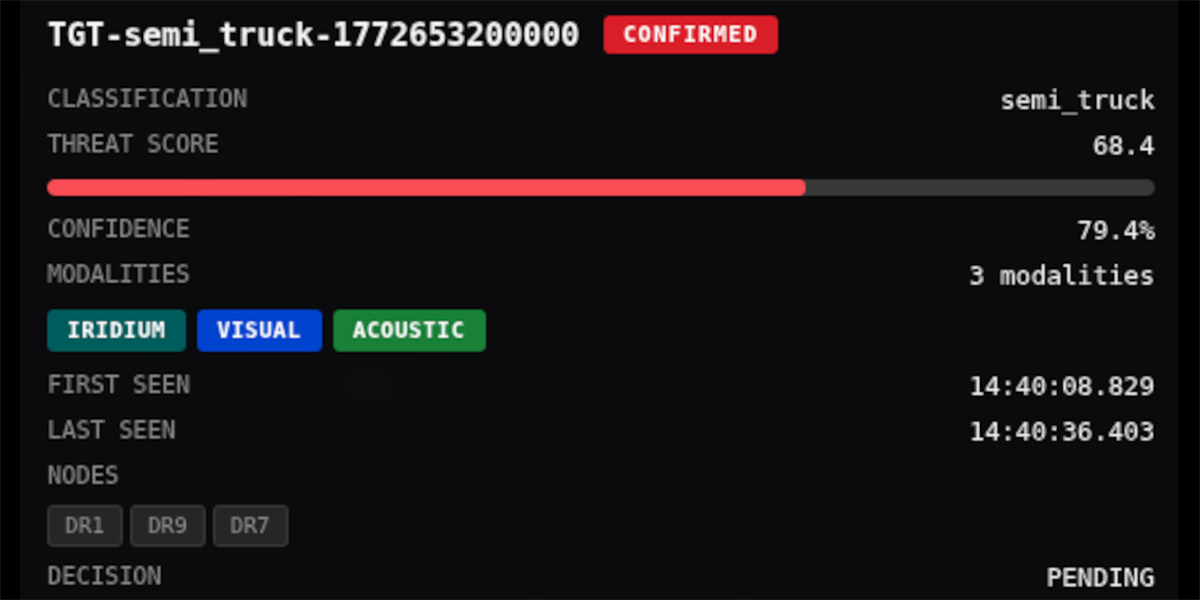
It appears Kevin has been working with AKIDA for a few months. We thought about 3 weeks?
It also appears his work with AKIDA has only just scratched the surface.
From comments scetion of latest post.

14h
Appreciate the kind words. Amazingly, I've only been working with Akida for a few months. I'm planning on a few things in the immediate future here: 1) Akida w/Symphony and the Prediction Markets--been slow boating historical data for a couple of weeks now, 2) Akida w/Symphony and IBM i/RPG, 3) Akida w/Symphony and World Monitor, 4) Akida w/Symphony Limit Order Book Diffusion models (hot Quant topic), and 5) Akida w/Symphony for satellite change detection. GPFS will also likely be involved with most of these as well. I'm also looking at Akida for network routing, stuff I've already tested but may apply in a different context. Lots to do!
My bold above.
It also appears his work with AKIDA has only just scratched the surface.
From comments scetion of latest post.
Kevin D. Johnson Author
Field CTO – HPC, AI, LLM & Quantum Computing | Principal HPC Cloud Technical Specialist at IBM | Symphony • GPFS • LSF14h
Appreciate the kind words. Amazingly, I've only been working with Akida for a few months. I'm planning on a few things in the immediate future here: 1) Akida w/Symphony and the Prediction Markets--been slow boating historical data for a couple of weeks now, 2) Akida w/Symphony and IBM i/RPG, 3) Akida w/Symphony and World Monitor, 4) Akida w/Symphony Limit Order Book Diffusion models (hot Quant topic), and 5) Akida w/Symphony for satellite change detection. GPFS will also likely be involved with most of these as well. I'm also looking at Akida for network routing, stuff I've already tested but may apply in a different context. Lots to do!
My bold above.
Given Kevin has revealed he has been working with AKIDA for several months and the sense of urgency about the US defense AI push would it be a surprise to see a partnership emerge between IBM and Brainchip in the next couple of months??
Especially if IBM want surety of chip supply.
Especially if IBM want surety of chip supply.

Frangipani
Top 20
News from our friends at OHB Hellas: Meet Hummingbird, their new small demonstrator, for which they used Akida “directly on the drone to perform real-time vehicle detection from RGB images, without any ground connection”!
OHB Hellas are translating their space onboard computing research to the UAV world: “We just flew neuromorphic AI on a small UAV - onboard, in real time, with very low power.”
“… an important step to explore technologies that can serve UAVs today and also satellite missions tomorrow.”

#uav #edgeai #neuromorphic #onboardcomputing #lowswap #aerospace #ohbhellas | OHB Hellas
We just flew neuromorphic AI on a small UAV — onboard, in real time, with very low power. At OHB Hellas, we try to bring our experience from space onboard computing also into the UAV world. Hummingbird is our new small demonstrator where we used Akida neuromorphic processor by BrainChip...www.linkedin.com
View attachment 94480
In his comment, OHB Hellas CTO and Managing Director Mathieu Bernou names the three researchers from the Orbital High Performance Computing (Orbital-HPC) team (https://www.ohb-hellas.gr/activities/orbital-hpc/) who worked on Hummingbird:
View attachment 94490
Niki Doulou: https://www.linkedin.com/in/niki-doulou-168944254/
View attachment 94491
Giannis Panagiotopoulos: https://www.linkedin.com/in/giannispanagiotopoulos/
View attachment 94492 View attachment 94493
Evgenios Tsigkanos: https://www.linkedin.com/in/evgenios-tsigkanos/
View attachment 94494 View attachment 94495
Checked out the LinkedIn profile of Stavros Messinis, whom OHB Hellas thanked for “the UAV platform and his invaluable support” in their post.
Turns out he founded and successfully ran an Athens-based UAV company called Smart Flying Machines from 2022 to 2024, which he then sold to Lambda Automata, now known as Delian Alliance Industries (taking their name from the Delian League, a 5th century BC anti-Persian defensive association of equal Greek city states under the hegemony of Athens, which gradually evolved into the Athenian Empire).
The mission of Delian Alliance Industries - with offices in Athens and London - is: “Deter.Detect.Defend. Autonomy for area denial and counter-drone” (www.delian.ai) and “Protect the West and its allies in an era of autonomous warfare.”

Introducing Delian Alliance Industries (formerly Lambda Automata). New name, same mission: Protect the West and its allies in an era of autonomous warfare. We take our name from the Delian… | Delian Alliance Industries
Introducing Delian Alliance Industries (formerly Lambda Automata). New name, same mission: Protect the West and its allies in an era of autonomous warfare. We take our name from the Delian League, one of the West's oldest military alliances. We do so at a time of geopolitical peril and...
View attachment 94497
View attachment 94506
From September 2024 to July 2025, Stavros Messinis was an Innovation Consultant with INTERWEAVE. His bio, which can still be found on their website, provides some additional info compared to his LinkedIn profile, such as that Smart Flying Machines was “a defense-tech company developing an intelligent aerial surveillance system”:

Stavros Messinis - Interweave Agency
Stavros Messinis, originally from South Africa, studied Electronic Systems Design and built a strong foundation in technology. He moved to Greece in 1996 and began his career as an Information Systems Manager at the British Foreign and Commonwealth Office in Athens. From 2000 to 2011, he served...interweaveagency.com
View attachment 94505
In June 2025, Stavros Messinis co-founded ResilienceTech Venture Partners (RTVP) with John Doxaras. The company appears to have two websites: https://fieldbox.cc/ as well as https://rtvp.cc/home.

#fieldbox #dualuse #resilience #wash #energyaccess #modularinfrastructure #humanitariantech #defencetech #newventure | Stavros Messinis
Time to take it out of stealth mode - Announcing FieldBox. (https://fieldbox.cc) After years of working in innovation and transformation across sectors, and after time spent in crisis zones, disaster-hit areas, and consulting with frontline field officers, I’m excited to share our next venture...
View attachment 94513
According to www.fieldbox.cc, the FieldBox business unit offers “modular container-based solutions designed for military and civilian operations across any terrain or climate”, including the option of a “UAV assembly, maintenance, and operations center for reconnaissance missions”.
ResilienceTech’s other website (www.rtvp.cc) advertises “Professional sales and comprehensive training programs for tactical first-person view systems and operations.”
LinkedIn Login, Sign in | LinkedIn
Login to LinkedIn to keep in touch with people you know, share ideas, and build your career.www.linkedin.com
View attachment 94499
They appear to be very well networked with the Greek military:

#resiliencetech #defenceinnovation #fpv #electronicwarfare #interop #fieldrepair #trainingreadiness #parmenion2025 #hellenicarmedforces #resiliencetechventurepartners #resiliencetech… | ResilienceTech
RTVP Field Report: Parmenion 2025 – Xanthi Last week, ResilienceTech Venture Partners (RTVP) took part in Parmenion 2025, Greece’s largest annual military exercise in Xanthi, alongside Hellenic Army and Special Forces units and eight defense industry partners. Our team demonstrated the CZ1...
“Last week, ResilienceTech Venture Partners (RTVP) took part in Parmenion 2025, Greece’s largest annual military exercise in Xanthi, alongside Hellenic Army and Special Forces units and eight defense industry partners.
Our team demonstrated the CZ1 Argus Fiber-Optic FPV platform, completing six live missions under varied weather and electronic warfare (EW) conditions.
These sorties delivered valuable insights into how EW interference, terrain masking, and adverse weather affect low-latency video and vehicle control.
A key takeaway: interoperability—technological and procedural—remains essential. The flow of information and coordination between units, systems, and partners define operational tempo and decision quality.”
A few weeks ago, Stavros Messinis reposted a post by his business partner - ResilienceTech co-founder John Doxaras - in which he announced they were bringing the European Defense Tech Hackathon to Athens in February:
View attachment 94511
European Defense Tech Hackathon – Athens · Luma | John Doxaras
When we started ResilienceTech with Stavros Messinis six months ago, we couldn’t have imagined the scale of the journey ahead. 🚀 Inspired by the harsh realities on the "unmanned Ukrainian frontlines", our vision of organizing modern military forces and armies with a startup mindset is being...
Stavros Messinis is listed as one of the organisers, alongside European Defense Tech Hub Co-Founder Benjamin Wolba and Mariia Onufriievych, a Ukrainian software engineer that recently joined EDTH in Berlin in a Sales & Operations role:

European Defense Tech Hackathon – Athens · Luma
Time to Accelerate European Defense Innovation 🚀 Join us and 120+ hackers from all across Europe and beyond for the European Defense Tech Hackathon on…luma.com
View attachment 94504
Around the same time, Stavros Messinis posted about his rather spontaneous, yet very successful collaboration with the “super-talented OHB Hellas team and their exceptional leadership”, which ultimately led to today’s LinkedIn post I shared earlier:
Proud to share a small but meaningful milestone for our team today! What started as a collaboration suggestion on Tuesday turned into a successful airborne test today, Thursday - flying an… | Stavros Messinis
Proud to share a small but meaningful milestone for our team today! What started as a collaboration suggestion on Tuesday turned into a successful airborne test today, Thursday - flying an experimental neuromorphic image-classification device on one of our UAVs together with OHB Hellas, the...
View attachment 94500
Sounds like both sides consider it a fruitful encounter indeed!
Shortly after, he also shared with his LinkedIn network that ResilienceTech had acquired another Greek company: Flybot (https://flybot.gr/en/about-us-2/):

Resilience Tech: Εξαγοράζει την ελληνική Flybot και αλλάζει το παιχνίδι στα drones - STARTUPPER | Stavros Messinis
LFG. Some important news to share. We acquired Flybot, one of Greece’s prime DJI service providers and a great example of true dual-use innovation in one of the most competitive domains today: drones and FPVs - serving both defense and civil protection. With Flybot joining the ResilienceTech...
View attachment 94512
Yesterday, ResilienceTech posted:

Indigenous FPV Drone Software Stack Developed in Greece for Armed Forces | ResilienceTech posted on the topic | LinkedIn
Over the past months, a small team from ResilienceTech and Flybot has been deep in the weeds developing an indigenous flight control software stack for FPV drones - built in Greece. It will be augmented by an indigenous hardware stack in the coming weeks too. Beyond the specs and the...
View attachment 94501
So it definitely appears worth keeping an eye on Stavros Messinis and ResilienceTech now that they have worked with OHB Hellas by jointly “flying an experimental neuromorphic image-classification device” (-> Akida onboard!) on one of their UAVs, which proved to be a win-win situation.
And it doesn’t seem far-fetched to imagine that Stavros Messinis as one of the organisers of the upcoming EDTH in Athens may have excitedly invited his new friends from OHB Hellas to join the hackathon next month…
Bingo!
OHB Hellas engineers Giannis Panagiotopoulos and Niki Doulou - both of whom were recently involved in creating the Hummingbird demonstrator, a small drone that combines a UAV platform provided by Stavros Messinis from Resilience Tech with Akida for image classification(“We just flew neuromorphic AI on a small UAV - onboard, in real time, with very low power.”) - gave a presentation on Neuromorphic Computing at the European Defense Hackathon in Athens on 27 February:
“… We thought about leveraging our experience and knowledge in space systems and the way that the data should be processed on a satellite that led us to think that a neuromorphic computer would fit perfectly on a drone…”
[The video goes on for about 7 more minutes.]
“… And I’m glad to say that maybe the next stage is for us to use an event-based camera in order to proceed with a more sophisticated solution about detecting with a drone something coming from [? unintelligible to me - the automatic transcript says “from the air”].”
Sign Up | LinkedIn
500 million+ members | Manage your professional identity. Build and engage with your professional network. Access knowledge, insights and opportunities.
View attachment 95669
View attachment 95671
The OHB Hellas team at the European Defense Tech Hackathon Athens 2026:
Giannis Panagiotopoulos (Space ML Engineer), Niki Doulou (Embedded Software Engineer) and Kyriakos Mimikos (Space Systems Engineer & Business Development Officer).
View attachment 95678 View attachment 95679
Currently under construction
 :
:A new OHB Hellas webpage, dedicated to the recently developed Hummingbird demonstrator, which sprang from a very spontaneous collaboration between three of their Orbital High-Performance Computing (Orbital-HPC ) researchers and the team around Stavros Messinis from Resilience Tech six weeks ago
.When you google “OHB Hellas Hummingbird”, the first result that comes up is this:
However, this specific “Products and Services” subpage is not yet accessible.
From the text snippet visible on Google we can gather that OHB Hellas clearly marks Hummingbird as experimental*, so I expect the webpage to go live long before Hummingbird might become a commercial product one day, similarly to the OHB Hellas GIASaaS (Global Instant Satellite as a Service) concept website (https://giasaas.eu):
https://thestockexchange.com.au/threads/brn-discussion-ongoing.1/post-462394
https://thestockexchange.com.au/threads/brn-discussion-ongoing.1/post-476913
*Note the use of the term“vision”.
As for the reason why OHB Hellas have decided to keep their “vision for the future of embedded intelligence for drones” under wraps for the time being, we can only speculate.
Maybe the OHB Hellas Orbital HPC team are working on a refined version of Hummingbird before they will release more info? After all, it took the researchers from OHB Hellas and Resilience Tech merely two days to proceed from a collaboration suggestion to a successful airborne test with Akida performing image classification onboard the small UAV:
Proud to share a small but meaningful milestone for our team today! What started as a collaboration suggestion on Tuesday turned into a successful airborne test today, Thursday - flying an… | Stavros Messinis
Proud to share a small but meaningful milestone for our team today! What started as a collaboration suggestion on Tuesday turned into a successful airborne test today, Thursday - flying an experimental neuromorphic image-classification device on one of our UAVs together with OHB Hellas, the...
Another potential reason (although less likely IMO) for continuing to keep the Hummingbird webpage hidden from public view for some time longer:
At the European Defense Tech Hackathon in Athens last week, Giannis Panagiotopoulos from OHB Hellas told the audience during his presentation on neuromorphic computing that they were also looking into adding a neuromorphic camera in order to create a more sophisticated solution for their drone to perform image detecting tasks:
“… And I’m glad to say that maybe the next stage is for us to use an event-based camera in order to proceed with a more sophisticated solution about detecting with a drone something coming from [? unintelligible to me - the automatic transcript says “from the air”].”
You will obviously have to check with your super provider, however i think it's a case of, you can only buy ASX300 companies but if you hold a company that drops out you do not have to sell.What does that mean if you have bpught through a super fund because its in the ASX 300 ?
smoothsailing18
Regular
Trump shuts down AI company from pentagon as they wont give him full control.
Anthropic says the Pentagon has declared it a national security risk
Anthropic says the Pentagon has declared it a national security risk
Frangipani
Top 20
Antonio said at the last AGM "We've talked to the ASX. We have made it clear to the ASX how we do business, and we will absolutely, when something we deem is truly material to the shareholders, we will absolutely put it on ASX"
So we have a new strategic customer posted on Linked In. Big news, but only big enough for Linked In.
It will be a good day when something is "truly material" and warrants an ASX announcement.
I get your frustration with regard to the sparsity of ASX announcements, @jrp173, but to be fair, we did first find out about this new customer (Nex Novus resp. their spin-out Neuromorphyx) through an ASX announcement, although not through a standalone one, but as part of the “Quarterly Activities Report and Appendix 4C For the Quarter ending December 2025” on 29 January 2026:
A similarly worded paragraph referring to Nex Novus/Neuromorphyx was also featured in another ASX announcement four weeks later, namely the 2025 Annual Report on 26 February 2026:
By the way, note the differently worded sentences published a month apart:
Earlier version: “On 12 December 2025, BrainChip received an initial order for 1,200 AKD1500 chips from Nex Novus for use in its Neuromorphyx™ “Neuro Blocks” product. The AKD1500 will accelerate an MCU supporting neuromorphic evaluation of multi-sensor data. While the order size is minor, it represents further market demand for the AKD1500.”
Later version: “On 12 December 2025, BrainChip received an order for 1,200 AKD1500 chips from Nex Novus for use in its Neuromorphyx™“Neuro Blocks” product. The AKD1500 will accelerate an MCU supporting neuromorphic evaluation of multi-sensor data. While the order size is modest, it underscores the growing commercial interest and real-world utility of the AKD1500.”
So this week’s press release and social media posts actually came after the ASX announcements, but provided much more detailed information about “Neuromorphyx’s rugged, modular architecture” as well as clarified that “Neuromorphyx is a deep-tech hardware and embedded software company, spun out of Nex Novus d.o.o., focused on high-performance, energy-efficient edge AI for defense, robotics and industrial sensing.”
IMO it is, however, totally legitimate to ask, why there wasn’t any standalone ASX announcement at the actual time when the order was placed, i.e., in mid-December 2025, and to wonder why the 5 March 2026 press release states “BrainChip Holdings Ltd (ASX: BRN, OTCQX: BRCHF, ADR: BCHPY), the world leader in ultra-low power, fully digital, event-based neuromorphic AI, today announced that Nex Novus d.o.o., Neuromorphyx™ has selected the Akida™ AKD1500 co-processor for evaluation and integration in its Vision NeuroNode™ edge-AI device.”
It reminds me of last year, when we found out on 28 January 2025 - through the 4C “for the Period ended 31 December 2024” - that “in late December, BrainChip signed a US$ 100,000 contract with U.S defence contractor Bascom Hunter, for the sale and support of AKD1500 chips for full scale evaluation of commercial products…”.
Again, why did this not warrant a standalone ASX announcement at the time of contract signing, i.e., a full month earlier?

smoothsailing18
Regular
Ask AI for fun...
Based on historical hardware refresh cycles and the deployment of specialized AI accelerators, a full upgrade would involve the purchase of approximately 500,000 to 1.2 million Akida-based units over a few years.This volume accounts for integration into IBM’s Power Systems and the z16 mainframe line, which increasingly utilize on-chip AI acceleration for real-time fraud detection and data processing.
M2 cards are $249 usd..... I would think that price shall be cut in half for such a quantity imo.
Iam sure there is alot more to it than this basic outline yet its a good thing to dream.
Based on historical hardware refresh cycles and the deployment of specialized AI accelerators, a full upgrade would involve the purchase of approximately 500,000 to 1.2 million Akida-based units over a few years.This volume accounts for integration into IBM’s Power Systems and the z16 mainframe line, which increasingly utilize on-chip AI acceleration for real-time fraud detection and data processing.
M2 cards are $249 usd..... I would think that price shall be cut in half for such a quantity imo.
Iam sure there is alot more to it than this basic outline yet its a good thing to dream.
smoothsailing18
Regular
Ask Ai share prices
The lowest expected share price for BrainChip Holdings Ltd. (BRCHF) in December 2026, based on current analytical modeling and historical volatility data, is approximately $0.8609 USD.This figure represents the "trough" or conservative estimate within a broader forecast range for that year. While the average predicted value for 2026 sits higher at approximately $1.356 USD, the lower bound reflects potential market corrections, delays in commercial adoption, or broader macroeconomic headwinds affecting the technology sector.
The lowest expected share price for BrainChip Holdings Ltd. (BRCHF) in December 2026, based on current analytical modeling and historical volatility data, is approximately $0.8609 USD.This figure represents the "trough" or conservative estimate within a broader forecast range for that year. While the average predicted value for 2026 sits higher at approximately $1.356 USD, the lower bound reflects potential market corrections, delays in commercial adoption, or broader macroeconomic headwinds affecting the technology sector.
Last edited:

IBM is close to plug and play for IBM and the only possible bottleneck is chip supply.
Parsons have strategically stitched up chip supply via contract.
IBM if it sees a future with AKIDA/Symphony is without a contract for supply is vulnerable to supply constraints should others get in first.
In theory IBM only needs the chips but in reality to secure chip supply it needs a partnership and contract.
No IBM customers whether defense, security or finance will sign decent $ contracts unless IBM has security of chip supply.
War Department Launches AI Acceleration Strategy to Secure American Military AI Dominance > U.S. Department of War > Release | U.S. Department of War
" "We will unleash experimentation, eliminate bureaucratic barriers, focus our investments and demonstrate the execution approach needed to ensure we lead in military AI,""
" The Department is taking a wartime approach to delivering capabilities, with an emphasis on three tenets: warfighting, intelligence and enterprise operations."
" The catalyst for this acceleration will be seven Pace-Setting Projects (PSPs), each with a single accountable leader and aggressive timelines. "
" the War Department will accelerate America's Military AI Dominance by becoming an AI-first warfighting force across all domains."
There is a rush to AI ify the military.
If IBM wants early mover in defense with Neuromorphic Edge AI it needs to move in months not years.
Parsons have strategically stitched up chip supply via contract.
IBM if it sees a future with AKIDA/Symphony is without a contract for supply is vulnerable to supply constraints should others get in first.
In theory IBM only needs the chips but in reality to secure chip supply it needs a partnership and contract.
No IBM customers whether defense, security or finance will sign decent $ contracts unless IBM has security of chip supply.
War Department Launches AI Acceleration Strategy to Secure American Military AI Dominance > U.S. Department of War > Release | U.S. Department of War
" "We will unleash experimentation, eliminate bureaucratic barriers, focus our investments and demonstrate the execution approach needed to ensure we lead in military AI,""
" The Department is taking a wartime approach to delivering capabilities, with an emphasis on three tenets: warfighting, intelligence and enterprise operations."
" The catalyst for this acceleration will be seven Pace-Setting Projects (PSPs), each with a single accountable leader and aggressive timelines. "
" the War Department will accelerate America's Military AI Dominance by becoming an AI-first warfighting force across all domains."
There is a rush to AI ify the military.
If IBM wants early mover in defense with Neuromorphic Edge AI it needs to move in months not years.

Learning
Learning to the Top 🕵♂️
Not sure if anyone post this...


And the comments:


Apology for the cut and paste.
And he from T Mobile...a major telecommunications of North America

www.linkedin.com
Learning
And the comments:
Apology for the cut and paste.
And he from T Mobile...a major telecommunications of North America
Neuromorphic Computing Revolution: Closing the AI Power Gap | Muhammad Arshad Khadim posted on the topic | LinkedIn
The Brain That Computes: Inside Neuromorphic's Quiet Revolution What if the next great leap in AI has nothing to do with bigger models? What if it's about building chips that think more like the brain that imagined them? That's the promise of Neuromorphic Computing — and I believe it's one of...
Learning
Last edited:
Apologies if posted already
Neuromorphic Computing: Re-Architecting Intelligence from the Ground Up
 www.linkedin.com
www.linkedin.com


Neuromorphic Computing: Re-Architecting Intelligence from the Ground Up
Neuromorphic Computing: Re-Architecting Intelligence from the Ground Up
For decades, computing has been dominated by the von Neumann architecture — a design that separates memory and processing, executes instructions sequentially, and underpins nearly every classical IT system. It has scaled impressively.
Neuromorphic Computing: Re-Architecting Intelligence from the Ground Up | Dr. Jochen Malinowski
Neuromorphic computing represents a fundamental shift in how we design and build intelligent systems. Instead of relying on the traditional von Neumann architecture with its strict separation of memory and processing, neuromorphic systems are inspired by the structure and dynamics of the human...
Frangipani
Top 20
DNB Asset Management - an incoming new institutional investor from Norway through their DNB Disruptive Muligheter (Disruptive Opportunities) Fund?
BrainChip gets a number of favourable mentions in the recent publication “Disruptive Perspektiver NO. 19 - EDGE AI”. The brochure’s three authors work for DNB Asset Management, Norway's oldest and largest asset management company: Audun Wickstrand Iversen, Portfolio Manager of the DNB Disruptive Opportunities and DNB Future Waves funds, Emilie Krutnes Engen (Portfolio Manager - DNB Disruptive Opportunities) and Leo Rundgren Olsen (Junior Analyst Equities - DNB Disruptive Opportunities).
The publication is accessible via a website named “Postkort fra fremtiden”, which means “Postcards from the Future”.

[The following translations from Norwegian Bokmål to English were done with Google Translate. Maybe one of our Norwegian or Danish shareholders can proofread the result and - if necessary - correct it…Takk!/Tak!]
“The purpose of Disruptive Perspectives:
When we analyze different topics, we spend a lot of time and many tools (quarterly reports, analyses, dialogue with companies, company visits, Excel, calculator and word models). We often make small notes, and sometimes large notes that we think of as perspectives. We are old enough to know that there are rarely truths, often just different perspectives.
Disruptive Perspectives has only one purpose: to share our perspectives on topics that shape our future. These are not academic notes, entries for an encyclopedia or recommendations to do something, buy or sell something. Just good old-fashioned information sharing to highlight how we see different topics at the time of publication. Perspectives do not become less, perhaps more, when shared. With that as a starting point; have a nice journey in our perspectives.”
Disclaimer
Innholdet i denne artikkelen er ikke ment som investeringsråd eller anbefalinger. Har du noen spørsmål om fondene det refereres til, bør du kontakte en finansrådgiver som kjenner deg og din situasjon. Husk også at historisk avkastning i fond aldri er noen garanti for fremtidig avkastning. Fremtidig avkastning vil blant annet avhenge av markedsutvikling, forvalterens dyktighet, fondets risiko, samt kostnader ved kjøp, forvaltning og innløsning. Avkastningen kan også bli negativ som følge av kurstap.
1. Kræsjkurs i DNB Disruptive Muligheter sitt rammeverk
Fondet har et bredt disruptivt globalt mandat, med MSCI World som referanseindeks. Ofte jakter vi asymmetri der andre ser risiko, og vi ser ofte volatilitet som en mulighet heller enn fare. Det er lyset som avslører konturene av et kommende Kuhnsk paradigmeskifte.
Porteføljen er strukturert rundt fem store investeringskategorier, som har vært rammeverket siden oppstarten av fondet i 2019:
• Connectivity
• Urban mobilitet
• Maskinrevolusjonen
• Demografi
• Knappe fysiske og digitale ressurser (Green deal)
“Disclaimer
The content of this article is not intended as investment advice or recommendations. If you have any questions about the funds referred to, you should contact a financial advisor who knows you and your situation. Also remember that historical returns in funds are never a guarantee of future returns. Future returns will depend, among other things, on market developments, the manager's skill, the fund's risk, and the costs of purchase, management and redemption. The return may also be negative as a result of capital losses.
1. Crash course in DNB Disruptive Opportunities' framework
The fund has a broad disruptive global mandate, with MSCI World as its benchmark index. We often hunt for asymmetry where others see risk, and we often see volatility as an opportunity rather than a danger. It is the light that reveals the contours of an upcoming Kuhnian paradigm shift.
The portfolio is structured around five major investment categories, which have been the framework since the fund's inception in 2019:
• Connectivity
• Urban mobility
• Machine revolution
• Demographics
• Scarce physical and digital resources (Green deal)”

“These rest on four innovation platforms we call “The Four Horsemen” (with a nod to both the Revelation of John and the heralds of the technological apocalypse):
1. Physical Horsemen (humanoids, drones, microrobots, etc.)
2. Digital Agents (Agentic AI that sees, reasons, and performs tasks on our behalf)
3. Relational Speech (Speech technology as the interface for the other three horsemen)
4. Self-driving devices (autonomous systems on land, sea, air and space)”
[…]
And behind all this are the three big enablers. The holy trinity of our time:
• Machine Learning (ML) • Semiconductors
• Batteries
In the long run, it's all about productivity (economic growth).
[…]

“BrainChip: the neuromorphic-spiking revolutionary who thinks like a brain on microwatts”
[…]


4. Company analysis – Core portfolio
We are expanding our screening from large cap to further down the value chain, towards micro/small cap (often under $1-2 billion) and midcap under $20 billion. It is in these segments that we find the highest growth. Our focus is on edge AI, AI glasses, laser (LiDAR), encryption in satellites, drones, last mile, and humanoid subcontractors (Western).
We are starting with 8 new candidates that complement the core companies (Tesla Optimus, ASTS, Google etc.). All are listed, positioned for the inflection point in the next 18 months.
[…]
4.1 BrainChip (BRN AU)
BrainChip is the most exciting of the four. The core is the Akida processor and their focus on neuromorphic computing. Instead of running a traditional neural network continuously, they build on spiking neural networks where computation is event-based. In practice, this means that the semiconductor wakes up when something actually happens in the sensor stream, and otherwise it is silent. The result is that it can work at the microwatt level, where more classic solutions often end up in watts and heat up.
This makes BrainChip relevant for AR glasses that need to see the world in real time without eating the battery. Humanoids, drones and last-mile robots that need to be able to reason locally and also function when the network is unstable or absent. In that sense, the case resembles a Christensen-type disruption against von Neumann logic and the heavy GPU world, not because the performance is necessarily the highest in an absolute sense, but because the energy profile opens up a new market where ultra low-energy inference is the whole point.
On the financial side, the company got an important breather with a $25 million capital raise in December 2025, which strengthens liquidity going forward and shifts focus more clearly towards commercializing Akida 2, as well as variants that can handle more modern GenAI needs. And at CES 2026, they showed several demos close to finished products, including together with MetaGuard AI in defense-grade cybersecurity, in addition to several other edge demonstrations. If this starts to stick in the ecosystem, it could ignite a field that provides more learning, more relevance and more demand. The classic spiral that makes edge a convex venture.
Table: Valley of Death and Early Scaling - BrainChip
[Columns from left to right:]
Valley of Death and Early Scaling
PoT (Proof of technology): fully proven Akida 2
validated spiking tech mature for edge (microwatts for vision/voice/reasoning)
PoBM (Proof of Business Model):
early but accelerating - revenue still low (historically under $1M annual) but
contracts partners growing (defense, industrial, cybersecurity)
gross margins potentially skyrocketing
(IP/fabless model, low marginal cost)
price/volume: license based
blue ocean in battery constrained devices
œecosystem building via cloud dev tools and partners
Early Commercialisation
makes the product/service available and affordable (disruptive innovation)
Early scaling: fabless/IP-heavy outsourced production (as Arm-like)
low vertical integration initially
but scalable as semiconductor
production theory: cost curve explodes down with volume
(neuromorphic is the future Moore's Law for power)
Valley of Death: coming out now - $25M funding & CES exposure gives runway into 2027 + Working capital strengthened, expertise strong (founders with deep-neuro background).
No longer dependent on constant dilution to survive
Rapid Scaling
unit costs
(Efficiency innovation)
Flywheel starts to spin
“In our interpretation, this is pure convexity. You get an early, steep inflection scenario where CES 2026 and the capital raising act as triggers, where the upside can come relatively quickly.
BrainChip also fits in nicely as a complement to the rest of the basket we already own. CEVA on IP, Kopin on displays, Ambarella on vision, Ouster on sensors. Akida could in an optimistic scenario become an actual brain component in the next generation of AI glasses or in more Optimus-like systems. Of the new candidates, it is therefore easy to argue that BrainChip has the highest upside if you get a clear OEM or platform owner that wins in the market.”


[…]
“Overall Overview
Our current position in the Edge AI landscape is fundamentally strong, with a portfolio that now covers the entire value chain from sensing to finished visual mapping. By combining perception from Ouster with the powerful image processing of Ambarella and CEVA, supported by display technology from Kopin and Himax, we have built a tech stack that is rigged for the demands of the future. The use of flexible solutions from Lattice and QuickLogic, together with robust software from OSS, means that we are significantly ahead of the S-curve in terms of energy-efficient inference. We effectively own the critical building blocks that enable low-power intelligence in the physical world.
However, our analysis has identified certain gaps where we can extract further asymmetric gains. While we are strong at the component level, Vuzix represents the missing link in the form of a complete AR system for both consumers and industry. At the same time, Indie Semiconductor and Pixelworks act as crucial supporting players, adding the necessary finishing touches through intelligent sensor fusion and visual polishing, respectively. To complete the stack in the long term, we are also looking at raw neuromorphic computing through players like BrainChip, which could give us a unique position in ultra-low-power learning that mimics the human brain.
CES 2026 has served as the starting point for a domino effect in the market. The strategic partnerships we are now seeing portend a massive escalation. Over the next 18 months, we expect explosive growth in the market for AI glasses and humanoid robots. This will trigger a Metcalfe flywheel, where the value of the technology increases exponentially as more devices connect and interact in physical space.
This development is at the core of what we define as the machine revolution and the future of urban mobility. We are moving away from static algorithms in the cloud and towards physical agents that operate autonomously in our everyday lives. This entire shift is enabled by the breakthroughs in semiconductor technology and low-power processing that we have now positioned ourselves in.
The conclusion is that we now have a solid convexity in our exposure. We are set for an early and steep growth phase as supply chains stabilize and technological reference designs finally meet the mass market.
Our top 3 for rotation or augmentation now:
1. Vuzix (fills void in AR)
2. BrainChip (future proof if neuromorphic AI takes off)
3. Increase CEVA/Kopin (traction and at inflection point)
4.14 Investment Universe and Summary
We now rank the entire edge AI universe we have built, both core positions and candidates, using our Ahead of the S-Curve framework. The goal is to separate the convexity in early steep inflection from the more mature winners where the business model and moat are already proven, but where the upside is typically more linear. The ranking therefore goes from the highest asymmetric upside, where we still have some valley of death risk but see clear triggers in the next 18-36 months, to the lowest, where the company is more in the mature steep or mature phase with high PoBM, lower multiples and a more defensive profile. We pay particular attention to the S-curve phase, Metcalfe flywheel, Christensen disruption and the connection to the Riders through humanoids, glasses and drones. The context is January 2026, with fresh signals from CES.
Ranked list, 1 is highest for asymmetry and new position, 12 is hold or increase less.
1. BrainChip (BRN AU) appears as pure, early convexity in the edge shift. PoT is proven through Akida and neuromorphic spiking, and PoBM is still early but more accelerating than through demos and more “real” product surfaces. Capital replenishment provides better endurance into commercialization, and the triggers are clear in 2026 to 2027 when GenAI on device becomes a requirement in battery-constrained form factors. The case is a classic blue ocean in ultra-low power consumption and the potential role as the “brain” in glasses, humanoids and drones provides the highest raw asymmetry in the universe.
2. Vuzix (VUZI US) …”


 www.spaceport-norway.com


BIO
Audun Wickstrand Iversen manages the DNB Disruptive Opportunities fund, ranked as the fifth-best equity fund in the world.
He began his career in finance in 1996 and was named Norway’s top telecom analyst. Since then, he has managed several successful funds, authored books, and founded multiple startups, as well as served on the boards of several publicly listed companies.
Audun holds a Master of Science in Economics and Business Administration from BI Norwegian Business School, an advanced degree from the Norwegian School of Economics (NHH), and a cand.mag. degree from the University of Oslo.


BrainChip is also featured in the very first publication from the Disruptive Perspektiver series: “NO. 1 AI-INFRASTRUKTUR”:
BrainChip gets a number of favourable mentions in the recent publication “Disruptive Perspektiver NO. 19 - EDGE AI”. The brochure’s three authors work for DNB Asset Management, Norway's oldest and largest asset management company: Audun Wickstrand Iversen, Portfolio Manager of the DNB Disruptive Opportunities and DNB Future Waves funds, Emilie Krutnes Engen (Portfolio Manager - DNB Disruptive Opportunities) and Leo Rundgren Olsen (Junior Analyst Equities - DNB Disruptive Opportunities).
The publication is accessible via a website named “Postkort fra fremtiden”, which means “Postcards from the Future”.
[The following translations from Norwegian Bokmål to English were done with Google Translate. Maybe one of our Norwegian or Danish shareholders can proofread the result and - if necessary - correct it…Takk!/Tak!]
“The purpose of Disruptive Perspectives:
When we analyze different topics, we spend a lot of time and many tools (quarterly reports, analyses, dialogue with companies, company visits, Excel, calculator and word models). We often make small notes, and sometimes large notes that we think of as perspectives. We are old enough to know that there are rarely truths, often just different perspectives.
Disruptive Perspectives has only one purpose: to share our perspectives on topics that shape our future. These are not academic notes, entries for an encyclopedia or recommendations to do something, buy or sell something. Just good old-fashioned information sharing to highlight how we see different topics at the time of publication. Perspectives do not become less, perhaps more, when shared. With that as a starting point; have a nice journey in our perspectives.”
Disclaimer
Innholdet i denne artikkelen er ikke ment som investeringsråd eller anbefalinger. Har du noen spørsmål om fondene det refereres til, bør du kontakte en finansrådgiver som kjenner deg og din situasjon. Husk også at historisk avkastning i fond aldri er noen garanti for fremtidig avkastning. Fremtidig avkastning vil blant annet avhenge av markedsutvikling, forvalterens dyktighet, fondets risiko, samt kostnader ved kjøp, forvaltning og innløsning. Avkastningen kan også bli negativ som følge av kurstap.
1. Kræsjkurs i DNB Disruptive Muligheter sitt rammeverk
Fondet har et bredt disruptivt globalt mandat, med MSCI World som referanseindeks. Ofte jakter vi asymmetri der andre ser risiko, og vi ser ofte volatilitet som en mulighet heller enn fare. Det er lyset som avslører konturene av et kommende Kuhnsk paradigmeskifte.
Porteføljen er strukturert rundt fem store investeringskategorier, som har vært rammeverket siden oppstarten av fondet i 2019:
• Connectivity
• Urban mobilitet
• Maskinrevolusjonen
• Demografi
• Knappe fysiske og digitale ressurser (Green deal)
“Disclaimer
The content of this article is not intended as investment advice or recommendations. If you have any questions about the funds referred to, you should contact a financial advisor who knows you and your situation. Also remember that historical returns in funds are never a guarantee of future returns. Future returns will depend, among other things, on market developments, the manager's skill, the fund's risk, and the costs of purchase, management and redemption. The return may also be negative as a result of capital losses.
1. Crash course in DNB Disruptive Opportunities' framework
The fund has a broad disruptive global mandate, with MSCI World as its benchmark index. We often hunt for asymmetry where others see risk, and we often see volatility as an opportunity rather than a danger. It is the light that reveals the contours of an upcoming Kuhnian paradigm shift.
The portfolio is structured around five major investment categories, which have been the framework since the fund's inception in 2019:
• Connectivity
• Urban mobility
• Machine revolution
• Demographics
• Scarce physical and digital resources (Green deal)”
“These rest on four innovation platforms we call “The Four Horsemen” (with a nod to both the Revelation of John and the heralds of the technological apocalypse):
1. Physical Horsemen (humanoids, drones, microrobots, etc.)
2. Digital Agents (Agentic AI that sees, reasons, and performs tasks on our behalf)
3. Relational Speech (Speech technology as the interface for the other three horsemen)
4. Self-driving devices (autonomous systems on land, sea, air and space)”
[…]
And behind all this are the three big enablers. The holy trinity of our time:
• Machine Learning (ML) • Semiconductors
• Batteries
In the long run, it's all about productivity (economic growth).
[…]
“BrainChip: the neuromorphic-spiking revolutionary who thinks like a brain on microwatts”
[…]
4. Company analysis – Core portfolio
We are expanding our screening from large cap to further down the value chain, towards micro/small cap (often under $1-2 billion) and midcap under $20 billion. It is in these segments that we find the highest growth. Our focus is on edge AI, AI glasses, laser (LiDAR), encryption in satellites, drones, last mile, and humanoid subcontractors (Western).
We are starting with 8 new candidates that complement the core companies (Tesla Optimus, ASTS, Google etc.). All are listed, positioned for the inflection point in the next 18 months.
[…]
4.1 BrainChip (BRN AU)
BrainChip is the most exciting of the four. The core is the Akida processor and their focus on neuromorphic computing. Instead of running a traditional neural network continuously, they build on spiking neural networks where computation is event-based. In practice, this means that the semiconductor wakes up when something actually happens in the sensor stream, and otherwise it is silent. The result is that it can work at the microwatt level, where more classic solutions often end up in watts and heat up.
This makes BrainChip relevant for AR glasses that need to see the world in real time without eating the battery. Humanoids, drones and last-mile robots that need to be able to reason locally and also function when the network is unstable or absent. In that sense, the case resembles a Christensen-type disruption against von Neumann logic and the heavy GPU world, not because the performance is necessarily the highest in an absolute sense, but because the energy profile opens up a new market where ultra low-energy inference is the whole point.
On the financial side, the company got an important breather with a $25 million capital raise in December 2025, which strengthens liquidity going forward and shifts focus more clearly towards commercializing Akida 2, as well as variants that can handle more modern GenAI needs. And at CES 2026, they showed several demos close to finished products, including together with MetaGuard AI in defense-grade cybersecurity, in addition to several other edge demonstrations. If this starts to stick in the ecosystem, it could ignite a field that provides more learning, more relevance and more demand. The classic spiral that makes edge a convex venture.
Table: Valley of Death and Early Scaling - BrainChip
[Columns from left to right:]
Valley of Death and Early Scaling
PoT (Proof of technology): fully proven Akida 2
validated spiking tech mature for edge (microwatts for vision/voice/reasoning)
PoBM (Proof of Business Model):
early but accelerating - revenue still low (historically under $1M annual) but
contracts partners growing (defense, industrial, cybersecurity)
gross margins potentially skyrocketing
(IP/fabless model, low marginal cost)
price/volume: license based
blue ocean in battery constrained devices
œecosystem building via cloud dev tools and partners
Early Commercialisation
makes the product/service available and affordable (disruptive innovation)
Early scaling: fabless/IP-heavy outsourced production (as Arm-like)
low vertical integration initially
but scalable as semiconductor
production theory: cost curve explodes down with volume
(neuromorphic is the future Moore's Law for power)
Valley of Death: coming out now - $25M funding & CES exposure gives runway into 2027 + Working capital strengthened, expertise strong (founders with deep-neuro background).
No longer dependent on constant dilution to survive
Rapid Scaling
unit costs
(Efficiency innovation)
Flywheel starts to spin
“In our interpretation, this is pure convexity. You get an early, steep inflection scenario where CES 2026 and the capital raising act as triggers, where the upside can come relatively quickly.
BrainChip also fits in nicely as a complement to the rest of the basket we already own. CEVA on IP, Kopin on displays, Ambarella on vision, Ouster on sensors. Akida could in an optimistic scenario become an actual brain component in the next generation of AI glasses or in more Optimus-like systems. Of the new candidates, it is therefore easy to argue that BrainChip has the highest upside if you get a clear OEM or platform owner that wins in the market.”
[…]
“Overall Overview
Our current position in the Edge AI landscape is fundamentally strong, with a portfolio that now covers the entire value chain from sensing to finished visual mapping. By combining perception from Ouster with the powerful image processing of Ambarella and CEVA, supported by display technology from Kopin and Himax, we have built a tech stack that is rigged for the demands of the future. The use of flexible solutions from Lattice and QuickLogic, together with robust software from OSS, means that we are significantly ahead of the S-curve in terms of energy-efficient inference. We effectively own the critical building blocks that enable low-power intelligence in the physical world.
However, our analysis has identified certain gaps where we can extract further asymmetric gains. While we are strong at the component level, Vuzix represents the missing link in the form of a complete AR system for both consumers and industry. At the same time, Indie Semiconductor and Pixelworks act as crucial supporting players, adding the necessary finishing touches through intelligent sensor fusion and visual polishing, respectively. To complete the stack in the long term, we are also looking at raw neuromorphic computing through players like BrainChip, which could give us a unique position in ultra-low-power learning that mimics the human brain.
CES 2026 has served as the starting point for a domino effect in the market. The strategic partnerships we are now seeing portend a massive escalation. Over the next 18 months, we expect explosive growth in the market for AI glasses and humanoid robots. This will trigger a Metcalfe flywheel, where the value of the technology increases exponentially as more devices connect and interact in physical space.
This development is at the core of what we define as the machine revolution and the future of urban mobility. We are moving away from static algorithms in the cloud and towards physical agents that operate autonomously in our everyday lives. This entire shift is enabled by the breakthroughs in semiconductor technology and low-power processing that we have now positioned ourselves in.
The conclusion is that we now have a solid convexity in our exposure. We are set for an early and steep growth phase as supply chains stabilize and technological reference designs finally meet the mass market.
Our top 3 for rotation or augmentation now:
1. Vuzix (fills void in AR)
2. BrainChip (future proof if neuromorphic AI takes off)
3. Increase CEVA/Kopin (traction and at inflection point)
4.14 Investment Universe and Summary
We now rank the entire edge AI universe we have built, both core positions and candidates, using our Ahead of the S-Curve framework. The goal is to separate the convexity in early steep inflection from the more mature winners where the business model and moat are already proven, but where the upside is typically more linear. The ranking therefore goes from the highest asymmetric upside, where we still have some valley of death risk but see clear triggers in the next 18-36 months, to the lowest, where the company is more in the mature steep or mature phase with high PoBM, lower multiples and a more defensive profile. We pay particular attention to the S-curve phase, Metcalfe flywheel, Christensen disruption and the connection to the Riders through humanoids, glasses and drones. The context is January 2026, with fresh signals from CES.
Ranked list, 1 is highest for asymmetry and new position, 12 is hold or increase less.
1. BrainChip (BRN AU) appears as pure, early convexity in the edge shift. PoT is proven through Akida and neuromorphic spiking, and PoBM is still early but more accelerating than through demos and more “real” product surfaces. Capital replenishment provides better endurance into commercialization, and the triggers are clear in 2026 to 2027 when GenAI on device becomes a requirement in battery-constrained form factors. The case is a classic blue ocean in ultra-low power consumption and the potential role as the “brain” in glasses, humanoids and drones provides the highest raw asymmetry in the universe.
2. Vuzix (VUZI US) …”
Spaceport Norway 2025, Audun Wickstrand Iversen
Spaceport Norway 2025: NEW connects industry, investors, and innovators across Europe’s growing space economy. A 12-hour event in Oslo featuring ESA, NOSA, DNB, and leading organisations exploring space, business, and resilience.
www.spaceport-norway.com
Audun Wickstrand Iversen
FUND MANAGER
DNB ASSET MANAGEMENT
BIO
Audun Wickstrand Iversen manages the DNB Disruptive Opportunities fund, ranked as the fifth-best equity fund in the world.
He began his career in finance in 1996 and was named Norway’s top telecom analyst. Since then, he has managed several successful funds, authored books, and founded multiple startups, as well as served on the boards of several publicly listed companies.
Audun holds a Master of Science in Economics and Business Administration from BI Norwegian Business School, an advanced degree from the Norwegian School of Economics (NHH), and a cand.mag. degree from the University of Oslo.
60 years of value creation for our customers
Cool headed. Warm hearted. Asset Management, the Nordic way.
A wide range of funds combined with specialized competence
DNB Asset Management is one of the leading asset managers in the Nordics and offers a wide range of equity and bond funds, Private Equity, and management services to individual customers, investors, and institutions in Norway and internationally through our offices in Stockholm, Luxembourg, Madrid, and Zurich.BrainChip is also featured in the very first publication from the Disruptive Perspektiver series: “NO. 1 AI-INFRASTRUKTUR”:
Frangipani
Top 20
Kevin D. Johnson has now trained ten BrainChip AKD1000 neuromorphic chips on Baroque music (feeding them individually with different instrumental works by Johann Sebastian Bach) to let them jointly play Johann Pachelbel's famous Canon in D, coordinated by IBM Symphony:
www.linkedin.com

Sign Up | LinkedIn
500 million+ members | Manage your professional identity. Build and engage with your professional network. Access knowledge, insights and opportunities.
Last edited:
Similar threads


- Replies
- 0
- Views
- 5K
- Replies
- 9
- Views
- 6K
- Replies
- 0
- Views
- 3K