BRN Discussion Ongoing

In regards to revenue. Current guidance, as I take it, direct From Sean himself as of yesterday.

Hop asked the question "When do you consider as likely a commercial timeline horizon for significant revenue?"

To which Sean responded "we believe this year will be significantly more than anything you've seen in the past" and then went on to add "and we're going to see 26, 27, 28 is the years that we really take off"

From memory our biggest revenue year to date has been 2022 with a touch over $5million US. Sean has stated that he believes this year will be significantly more. That's a couple of big statements to make if you have nothing to back it up.

It seems prety clear to me.
Made plenty of statements but how many have come thru?
When will we see a deal that turns the company positive overnight,
Dipping in for capital raises and leaning on the Borrowing mob need to become a thing of the past,
No point dot joining shareholders need facts,
Watch us Now well tell us man or prove it with $$$$$$$
 
  • Like
  • Fire
Reactions: 5 users

IloveLamp

Top 20
1000021808.jpg
 
  • Like
  • Fire
  • Love
Reactions: 23 users

HopalongPetrovski

I'm Spartacus!
Made plenty of statements but how many have come thru?
When will we see a deal that turns the company positive overnight,
Dipping in for capital raises and leaning on the Borrowing mob need to become a thing of the past,
No point dot joining shareholders need facts,
Watch us Now well tell us man or prove it with $$$$$$$
Maybe just hit repeat on your post three or four more times and then you can have the weekend off.
Maybe try sky diving? 🤣
 
  • Haha
  • Like
  • Thinking
Reactions: 10 users

Bravo

Meow Meow 🐾
In regards to revenue. Current guidance, as I take it, direct From Sean himself as of yesterday.

Hop asked the question "When do you consider as likely a commercial timeline horizon for significant revenue?"

To which Sean responded "we believe this year will be significantly more than anything you've seen in the past" and then went on to add "and we're going to see 26, 27, 28 is the years that we really take off"

From memory our biggest revenue year to date has been 2022 with a touch over $5million US. Sean has stated that he believes this year will be significantly more. That's a couple of big statements to make if you have nothing to back it up.

It seems prety clear to me.


Hi Okeydockey,

I’m tending towards the more cautious side here, mainly because Sean has a habit of framing things quite optimistically (i.e. the “watch this space” style messaging).

The key question for me is what type of revenue he was referring to. Is this chip revenue, or licensing? To me, it’s likely he’s talking about total revenue, which would include licensing, NRE, and potentially small chip volumes, NOT mass commercial adoption. The wording doesn’t suggest volume ramp. If that were the case, you’d expect more explicit references to orders, production, or scaling, not just a broad statement about revenue being higher.

It also raises the question around the previously mentioned $9M bookings target that wasn’t achieved. Is this now expected to land in the near term and effectively roll into this year’s revenue outlook?

On the “2026–2028 takeoff” comment, that actually sounds more realistic because that aligns with typical design cycles and the time it takes to move from engagement to volume production.

Looking at the company’s own AKD1500 numbers (74,000 units in 2027) that’s still relatively small in semiconductor terms and doesn’t point to meaningful scale yet.

As I've said before, I think AKD2000 will ultimately be the volume play, but that’s still early in its lifecycle and will take time to translate into both licensing and unit sales.

So for now, I’d expect some revenue growth this year (likely licensing-led) with fairly modest chip contribution and any real scaling pushed out toward mid/late 2027 into 2028, but, that's just my thoughts whatever they're worth.
 
  • Like
  • Love
  • Fire
Reactions: 14 users

Gazzafish

Regular
Am I the only one who gets little if no response from the IR@brainchip.com email address? I understand that not all questions can be answered but I would expect to at least receive a response saying something like “Thanks for your query but unfortunately we can not disclose that Information at this time”. To simply not respond to shareholders questions is NOT acceptable.
 
  • Like
  • Fire
Reactions: 11 users

HopalongPetrovski

I'm Spartacus!
Am I the only one who gets little if no response from the IR@brainchip.com email address? I understand that not all questions can be answered but I would expect to at least receive a response saying something like “Thanks for your query but unfortunately we can not disclose that Information at this time”. To simply not respond to shareholders questions is NOT acceptable.
Agree. They seem to be either incompetent, arrogant or just unwilling to engage with investors which is contra indicated for a company designated to manage "investor relations". 🤣

Get In Touch


We’ll get Right Back to You...............................................🤣
 
  • Like
  • Fire
Reactions: 3 users
Hi Okeydockey,

I’m tending towards the more cautious side here, mainly because Sean has a habit of framing things quite optimistically (i.e. the “watch this space” style messaging).

The key question for me is what type of revenue he was referring to. Is this chip revenue, or licensing? To me, it’s likely he’s talking about total revenue, which would include licensing, NRE, and potentially small chip volumes, NOT mass commercial adoption. The wording doesn’t suggest volume ramp. If that were the case, you’d expect more explicit references to orders, production, or scaling, not just a broad statement about revenue being higher.

It also raises the question around the previously mentioned $9M bookings target that wasn’t achieved. Is this now expected to land in the near term and effectively roll into this year’s revenue outlook?

On the “2026–2028 takeoff” comment, that actually sounds more realistic because that aligns with typical design cycles and the time it takes to move from engagement to volume production.

Looking at the company’s own AKD1500 numbers (74,000 units in 2027) that’s still relatively small in semiconductor terms and doesn’t point to meaningful scale yet.

As I've said before, I think AKD2000 will ultimately be the volume play, but that’s still early in its lifecycle and will take time to translate into both licensing and unit sales.

So for now, I’d expect some revenue growth this year (likely licensing-led) with fairly modest chip contribution and any real scaling pushed out toward mid/late 2027 into 2028, but, that's just my thoughts whatever they're worth.
I share a lot of your thoughts here Bravo. I think we are all a little battle weary given the last few years. If we had made no progress over the last 12 months then I would view Sean's comments differently.

I to, am expecting revenue in 2026 to come primarily from license based streams rathe rather explosive levels of chip sales, I think a target revenue figure of 5-10mil would support this. Essentially I believe we will achieve commercial validation in 2026 and my hope is that this will be the catalyst for the market to consider the company as de-risked enough to begin to factor in potential future earnings into valuations which will drive share price growth.

Cautiously optimistic!
 
  • Like
  • Love
  • Fire
Reactions: 15 users

7For7

Regular
Sorry if already posted


IMG_0947.jpeg
 
  • Love
  • Like
  • Fire
Reactions: 13 users

jrp173

Regular
Am I the only one who gets little if no response from the IR@brainchip.com email address? I understand that not all questions can be answered but I would expect to at least receive a response saying something like “Thanks for your query but unfortunately we can not disclose that Information at this time”. To simply not respond to shareholders questions is NOT acceptable.

No this is standard behaviour from IR (Lancaster Grove and BrainChip).

Most emails from shareholders are ignored (you'll see the same theme appears in the other place too, as multiple people have posted about this)

I actually did get a reply recently to a very generic question a few months back and I almost fell over when I saw the reply in my inbox, as 99% of my emails have been ignored.. not even an automated "Thank you for your email...."

One can only assume that Lancaster have been directed by BrainChip to not engage with shareholders. Why else would they continually ignore emails from shareholders when they are on a monthly retainer from BrainChip? It makes no sense at all. It's like BrainChip think shareholders will stop asking questions if they just continually ignore us!
 
Last edited:
  • Like
  • Fire
Reactions: 5 users

Frangipani

Top 20
Just thinking out loud to myself ,


So we know we have some fancy radar offering ,

View attachment 96509

And we know that ASICLAND is designing an AKD2500 ASIC for tapeout to provide validation samples ,


View attachment 96511

And we know that Brainchip have gone to great lengths to tell us that it does not include customer orders ,


View attachment 96512

And we know about our partnership with Forward Edge and their little circle of defence and military friends ,


View attachment 96513


Including L3 Harris ,


View attachment 96514


Now , what we probably don’t know is L3 Harris have the below radar system ,

View attachment 96515

And looking at this report , which is apparently fact checked ,


View attachment 96516


And within the report we see that Brainchip and L3 Harris have a strategic partnership to intergrate Akida 2 into the Silent Knight radar system and the prototype is scheduled for Q3 2026 . I also believe that Brainchip will receive a small portion of the $18.5M contract , so it might pay to keep our eyes open to see how this one plays out .


View attachment 96517


Hi Doz,

it appears you have based your dot joining on yet another GenAI hallucination.

The AI Overview you shared falsely claims that L3Harris has something to do with the AN/APQ-187 Silent Knight radar system.

In reality, though, it is Raytheon that has been (for almost two decades) and continues to be the contractor awarded by the US Special Operations Command (SOCOM) to develop and manufacture the Silent Knight radar systems:


Raytheon Wins $135.4 Million Silent Knight Radar Development Contract​

MCKINNEY, Texas, Jan. 10, 2007 /PRNewswire/ -- The U.S. Special Operations Command has awarded Raytheon Company (NYSE: RTN) a $135.4 million contract to develop a new tactical radar for rotary and fixed-wing aircraft.

Formally signed Dec. 12, 2006, and initially funded at $28.5 million, the system design and development contract calls for Raytheon to build, test and integrate the new Silent Knight radar. The system will serve as a common multi-mode terrain following/terrain avoidance radar for a variety of platforms including the MH-47G helicopter, the lead aircraft for the program.

The cost plus incentive fee contract, potentially valued at more than $164 million, contains an option for six low rate initial production units. Raytheon Space and Airborne Systems is performing the work in Dallas and McKinney, Texas. Principal partners include AIC, Crestview, Fla.; DRS Technologies, St. Louis, Mo.; and Rockwell Collins, Cedar Rapids, Iowa.

"This win continues Raytheon's leadership in the tactical radar marketplace," said Mike Proch, vice president, Raytheon Precision, Attack and Surveillance Systems. "For our special operations forces customer, that means the expertise and experience to provide a low-risk, high-performance radar that meets its demanding mission requirements."

The Silent Knight radar will allow airborne forces safe low-level flight and safe ingress and egress in adverse environments. The system will also provide navigation support, ground mapping and weather information to air crews. The new radar will include advances in terrain following and avoidance capabilities and will be lighter and require less power than predecessors. As a common system, Silent Knight eventually will be fielded on MH-60M, MC-130H, and CV-22 block 30 aircraft.

Raytheon Space and Airborne Systems is the leading provider of sensor systems giving warfighters the most accurate and timely information available for the network-centric battlefield. With 2005 revenues of $4.2 billion and 13,000 employees, SAS is headquartered in El Segundo, Calif., with additional facilities in Goleta, Calif.; Forest, Miss.; Dallas, McKinney and Plano, Texas; and several international locations.

Raytheon Company, with 2005 sales of $21.9 billion, is an industry leader in defense and government electronics, space, information technology, technical services, and business and special mission aircraft. With headquarters in Waltham, Mass., Raytheon employs 80,000 people worldwide.

Note to Editors
This contract award was originally announced by the Department of Defense on Dec. 11, 2006.
Contact:
Dave Desilets
972.952.2239
SOURCE: Raytheon Company
CONTACT: Dave Desilets of Raytheon Company, +1-972-952-2239
Web site: http://www.raytheon.com/


RTX Books $321M SOCOM Contract for Silent Knight Radar System Production​

RTX (NYSE: RTX) will continue manufacturing and supplying terrain-following/terrain-avoidance radars and spare components under a five-year, $321.27 million contract from Special Operations Command.

Work on Silent Knight Radar systems will be conducted in McKinney, Texas; and Forest, Mississippi, through Dec. 31, 2028, the Department of Defense said Monday.


SOCOM will use $27.5 million in Foreign Military Sales funding for the sole-source award.

In December 2020, the then Raytheon Technologies company was awarded a multiyear, $235.6 million contract for Silent Knight radar production and delivery.
The multimode radar technology is developed to lessen the probability of military aircraft being detected by adversarial forces. It works to mask terrain for aircraft and crew protection.


Let’s also have a closer look at the “Neuromorphic Computing for Defense Market” article you shared, which supposedly got “fact-checked” by a certain Senior Consultant called Vaibhav Chandola.

LOL! That claim of factuality is total BS, judging from the section below alone, which is brimming with misinformation and/or GenAI hallucinations.
I have established for myself that not a single of those paragraphs is true! Feel free to disprove me.


E4E36C80-9512-4D25-A319-C4140267B40B.jpeg


There are multiple red flags 🚩 🚩🚩:

“February 2026

BrainChip Holdings Ltd. - Announced a strategic partnership with L3Harris Technologies to integrate the Akida 2 neuromorphic processor into L3Harris's AN/APQ-187 Silent Knight radar system for autonomous target classification, with initial prototype delivery scheduled for Q3 2026 under a U.S. Army SBIR Phase III contract valued at $18.5 million.”

- First and foremost: BrainChip did not announce any strategic partnership with L3Harris Technologies last month!
Did you really consider it possible that no one across the BRN forums would have spotted and posted about such a major announcement, if there had been any?

- As per above, L3Harris isn’t even working on the AN/APQ-187 Silent Knight radar system.

- Besides, BrainChip had not been awarded any relevant prior SBIR I or II contracts, which is obviously a prerequisite for transitioning to Phase III:


“A three-phased program, Army SBIR|STTR begins with a short proposal to determine the merit and feasibility of an innovation, leading to a major R&D effort that funds the prototyping and demonstration of the most promising projects. Next step? Commercialization. Phase III SBIR|STTR projects derive from, extend or complete work conducted under prior SBIR|STTR funding agreements but receive funding from sources other than the SBIR|STTR Program.

- Also, I’d love to know who would have been funding the whopping $18.5 million (!) for the (fictitious) US Army SBIR Phase III contract? The money would not have come from any SBIR/STTR fund, that’s for sure.👇🏻

And why did you say you believed BrainChip would only receive “a small portion of the $18.5M contract”? After all, they would have been the Small Business mainly profiting from the contract award, not their subcontractor(s), right?


Phase III awards are commercial applications of a company’s products, tools or services that receive funding from non-Army SBIR|STTR Program sources, such as the government or private sector.They can receive funding from any type of agency funds and can be any type of contract, with no limit on the number, duration, type or dollar value of the award. These characteristics create significant flexibility and opportunity for companies who have completed a Phase I or Phase II SBIR|STTR contract.

(…) Phase III monies can come from the government — except SBIR|STTR funds — and/or the private sector.”


- Phase III contracts are based on prior Phase I/II contracts and are all about transitioning to commercialisation. Why then would that mysteriously evasive Army SBIR Phase III contract reference an “initial prototype delivery scheduled for Q3 2026”? Isn’t a prototype something that would have already been developed during Phase I or II?


Plenty of more red flags regarding the other “latest industry developments”: 🚩🚩🚩

- Intel Loihi 2 was always conceptualised as a research chip. It is neither commercially available in general nor did Intel release a “Loihi 2 Defense Edition” in January.

- The DARPA program name INTACT stands for “Intrinsically Tough and Affordable Ceramics Today” and not for “Intelligent Neural Technologies for Autonomy in Contested Terrain” as alleged in the article.

Besides, there is no public record of any such November 2025 DARPA award relating to neuromorphic edge processors.

Last but not least, SynSense de facto became a Chinese company, when they relocated their HQs from Zurich to Chengdu in 2020. While some defense-related entities from the Western world such as the Swedish Defense Research Agency (FOI) have been experimenting with SynSense products (eg. Speck https://arxiv.org/pdf/2509.12997v1 “Drone Detection Using a Low-Power Neuromorphic Virtual Tripwire”), it is hard to believe that DARPA would select a company headquartered in China as a prime contractor to develop disruptive technology for the US military and not worry about creating national security risks.

- Samsung has not unveiled a defense-grade neuromorphic processor called ExNOS-D1. (The name is reminiscent of the existing Samsung Exynos SoC series).

- Prophesee did not list any contract with France's DGA on their “Everything that Happened at Prophesee in 2025” webpage (https://www.prophesee.ai/2026/01/07/prophesee-recap-2025/), plus they would not have been able to offer a “complete sensor-processor stack” to the French Defense Agency all by themselves.

- GrAI Matter Labs can’t have completed “a $35 million Series B funding round led by Lockheed Martin Ventures and In-Q-Tel, the venture capital arm of the U.S. intelligence community” in April 2025, as the company no longer existed at the time - they were quietly acquired by Snapchat’s parent company Snap in October 2023.
(https://www.eetimes.com/has-grai-matter-labs-been-snapped-up-by-snap-inc/)

- When you search for the project name "Neuromorphic Space Computing Experiment (NSCE)" on Google, the only (!) result that comes up is a link to the above article containing lots of “alternative facts”:

4C19FDDC-6383-44A1-84B2-A7E32C3F33EE.jpeg


Just more AI slop, that’s all, I’m afraid.

And by no means a trustworthy source of information regarding any proof of engagement with L3Harris.


P.S.: We do, however, happen to have an ex-employee working for them. I’m talking about Krishnamurthy Vemuru, who left BrainChip in August 2023 and has been working for L3Harris as Chief Systems Engineer/Scientist - AI/ML since May 2025:


C0234762-26D2-47B7-BFAF-61DFA2C661F3.jpeg
 
Last edited:
  • Fire
  • Like
  • Love
Reactions: 14 users

Diogenese

Top 20
In regards to revenue. Current guidance, as I take it, direct From Sean himself as of yesterday.

Hop asked the question "When do you consider as likely a commercial timeline horizon for significant revenue?"

To which Sean responded "we believe this year will be significantly more than anything you've seen in the past" and then went on to add "and we're going to see 26, 27, 28 is the years that we really take off"

From memory our biggest revenue year to date has been 2022 with a touch over $5million US. Sean has stated that he believes this year will be significantly more. That's a couple of big statements to make if you have nothing to back it up.

It seems prety clear to me.
Dust off your hockey stick!
 
  • Haha
Reactions: 7 users

rgupta

Regular
In regards to revenue. Current guidance, as I take it, direct From Sean himself as of yesterday.

Hop asked the question "When do you consider as likely a commercial timeline horizon for significant revenue?"

To which Sean responded "we believe this year will be significantly more than anything you've seen in the past" and then went on to add "and we're going to see 26, 27, 28 is the years that we really take off"

From memory our biggest revenue year to date has been 2022 with a touch over $5million US. Sean has stated that he believes this year will be significantly more. That's a couple of big statements to make if you have nothing to back it up.

It seems prety clear to me.
May be he is trying to sow seeds of confusion. None of his statements hold true. May be he start realising how crucial is this AGM. Definitly need more insurances than just talking.
Let us see if he can show some concrete plan of execution before the AGM or it will be a hard one for everyone.
Dyor
 
Last edited:
  • Fire
Reactions: 1 users

Frangipani

Top 20
A new Master’s Thesis titled “Spiking Neural Networks in the Physical Layer of Wireless Communication Systems”, which will be jointly supervised by the fortiss Neuromorphic Computing team and the Advanced Communication Systems and Embedded Security Lab (ACES Lab) at the TUM Chair of Theoretical Information Technology, may or may not end up involving Akida 2:

“This thesis focuses on designing and implementing SNNs to address selected physical-layer tasks, such as channel estimation. Initially, the performance of the implemented SNN will be evaluated through simulations of the SNN on GPUs. Subsequently, the network will be deployed on the best suitable specialized hardware platform (such as SpiNNaker2, Pulsar, Loihi 2, Akida 2) to assess real-time performance under practical constraints, including latency and energy consumption.”


MASTERARBEIT – SPIKING NEURAL NETWORKS IN THE PHYSICAL LAYER OF WIRELESS COMMUNICATION SYSTEMS (M/F/D)​

  • fortiss GmbH Jobportal
  • Collage Thesis
MASTERARBEIT – SPIKING NEURAL NETWORKS IN THE PHYSICAL LAYER OF WIRELESS COMMUNICATION SYSTEMS (M/F/D), 1. image

Who are we?​

fortiss is the research institute of the Free State of Bavaria for software-intensive systems and services with headquarters in Munich. The institute currently employs around 150 employees, who collaborate on research, development and transfer projects with universities and technology companies in Bavaria, Germany and Europe. Research is focused on state of the art methods, techniques and tools of software development, systems & service engineering and their application to reliable, secure cyber-physical systems, such as the Internet of Things (IoT). fortiss has the legal structure of a non-profit limited liability company (GmbH). Its shareholders are the Free State of Bavaria (as majority shareholder) and the Fraunhofer Society for the Promotion of Applied Research.

This master’s thesis will be jointly supervised by the Neuromorphic Computing team at fortiss and the ACES Lab at the Chair of Theoretical Information Technology.

In the design of wireless communication systems, models, such as channel models, have traditionally played a crucial role. However, these models always represent an idealized simplification and cannot fully capture all practical complexities. In contrast, data-driven approaches based on deep neural networks eliminate the need for explicit modeling and therefore have the potential to outperform classical designs. Current research explores deep learning techniques for tasks such as channel estimation, signal detection and modulation / demodulation, channel encoding and decoding, and physical-layer authentication.

Spiking neural networks (SNNs) are a novel type of neural network and differ fundamentally from conventional deep learning models by incorporating temporal dynamics and event-driven computation. SNNs operate using discrete spikes, similar to biological neurons, offering advantages in energy efficiency and temporal processing. Due to their event-driven, energy-efficient nature, SNNs are gaining attention in communications research.

This thesis focuses on designing and implementing SNNs to address selected physical-layer tasks, such as channel estimation. Initially, the performance of the implemented SNN will be evaluated through simulations of the SNN on GPUs. Subsequently, the network will be deployed on the best suitable specialized hardware platform (such as SpiNNaker2, Pulsar, Loihi 2, Akida 2) to assess real-time performance under practical constraints, including latency and energy consumption. Furthermore, data from USRP X410 software-defined radios (SDRs) will be utilized to study the performance on real-world data.

Your tasks:​

  • Literature review and collegial choice of the most appropriate task (channel estimation, signal detection, channel encoding, interference management) for an SNN implementation. Considered will be the maturity of the state-of-the-art, hardware constraints, hardware capabilities, and implementation complexity
  • Design and implementation of an SNN (selecting a suitable neuron model, encoding scheme, and learning algorithm) for the selected task in software (CPU/GPU)
  • Port and deployment of the SNN on neuromorphic hardware
  • Performance evaluation (with synthetic and real-world data) and comparison to traditional approaches

Your profile:​

  • Knowledge of wireless communication systems
  • Knowledge of neural networks and classical AI frameworks
  • Programming experience in MATLAB and Python
  • Experience with spiking neural networks (SNNs) and spiking frameworks is a plus

Did we catch your interest?​

Please submit your application via this fortiss application form AND email it to Ullrich Mönich (moenich@tum.de) with the subject line “Master’s thesis: Neuromorphic Comm”, including your CV and academic transcript.

Job-ID: NC-MA-01-2026

Contact: Dr. Axel von Arnim


Advanced Communication Systems and Embedded Security Lab (ACES Lab)​

The Advanced Communication Systems and Embedded Security Lab (ACES Lab) at the Chair of Theoretical Information Technology is dedicated to experimentally demonstrating and verifying novel communication concepts and analyzing their achievable performance gains.

Research Topics​

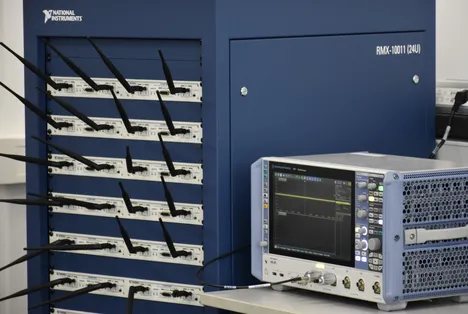
csm_rack_osc_s_3686d61055.webp


Our current research topics are:

Ongoing and Past Projects​

Current projects associated with the ACES Lab are:

Open PhD Positions​

There are open several open PhD positions in the above projects. For details, please see our job offers.

Note: Not all positions are advertised in the section "job offers". If you are interested in one of the topics above and have excellent grades, please do not hesitate to submit an unsolicitated application to jobs.lti@ei.tum.de. Please include the following documents:
  • Curriculum vitae, copies of relevant certificates and diplomas, contact information for two references
  • Short description of your research interests and your motivation for the application
  • Master thesis and (if available) up to 3 publications

Student Lab​

In addition to research, the ACES Lab is engaged in educating students. Since the Summer Semester of 2020 onwards, we have been offering course Software Defined Radio Laboratory in which students can explore fundamentals of wireless communication using a software defined radio system.

Research Possibilities​

We are offering Master thesis topics and topics for your "Forschungspraxis", as well as student jobs for outstanding students that are interested to participate in the research done in the ACES Lab. If you would like to join us, please send your application with a short motivation letter indicating your research interests, together with your CV and transcript to Ullrich Mönich (moenich@tum.de).

Contact: Dr.-Ing Ullrich Mönich


Ullrich J. Mönich​

Lehrstuhl für Theoretische Informationstechnik, Technische Universität München​


Current Research Interests​

My research interests are in the areas of signal processing, wireless communications, machine learning, and sampling theory.
Below current and past research topics are presented in more detail.

Neuromophic Computing​

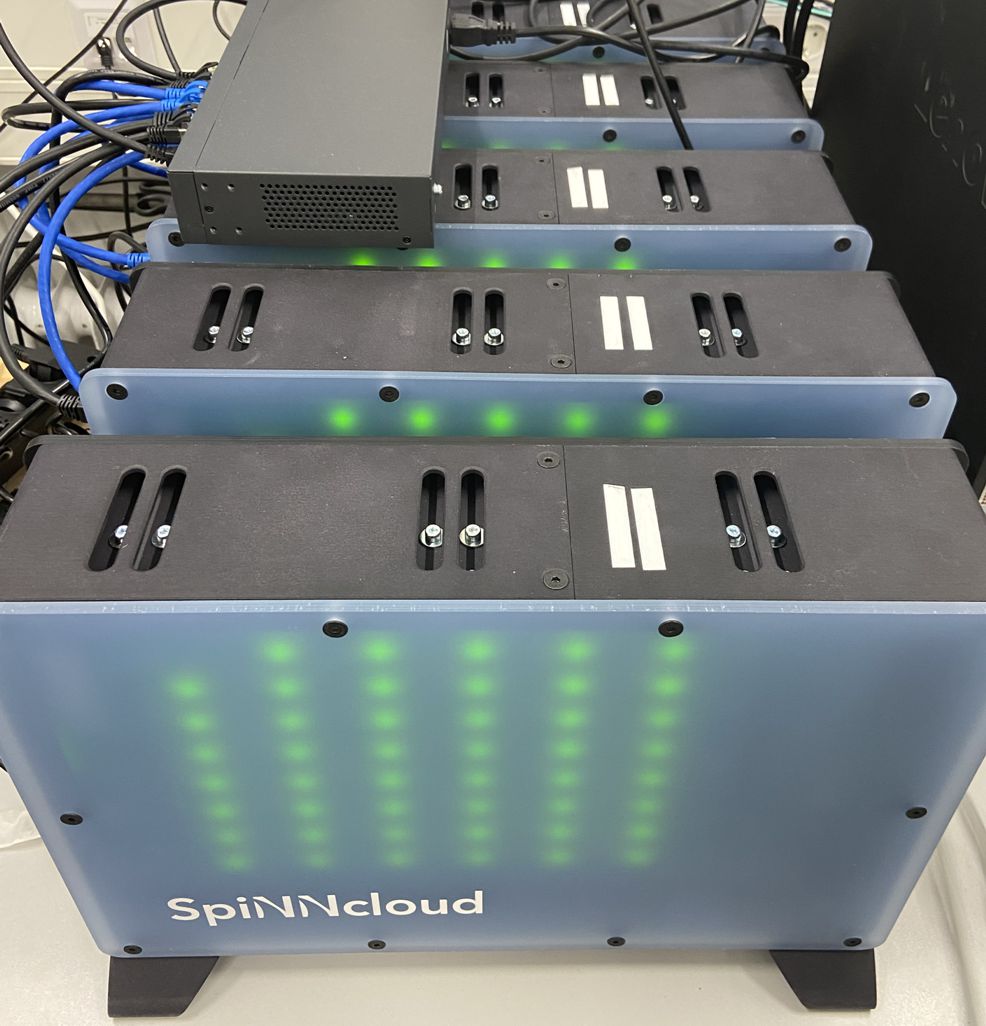
SpiNNaker2 System With 48 Chips

The novel computing approach of neuromorphic computing mimics the functioning of biological brains in hardware. Spiking neural networks (SNNs) encode information in the form of discrete impulses (spikes), similar to the action potentials in biological neurons. This can lead to greatly improved energy efficiency for certain signal processing tasks. Key research questions are: How can we harness the power efficiency of spiking neural networks in applications? How does the performance of SNNs compare to classical neural networks? In the ACES Lab we use the SpiNNaker2 hardware to study the above questions for applications related to wireless communications and signal processing.
  1. Alexandru-Paul Drăguţoiu, Vlad Andrei, Yin Li, Gabriel Béna, Mahmoud Akl, Matthias Lohrmann, Ullrich Mönich, and Holger Boche, "Neuromorphic Localization and Communication Using 5G Waveforms", 2025 59th Asilomar Conference on Signals, Systems, and Computers, Oct. 2025, accepted.

(…)
 
Last edited:
  • Like
  • Love
Reactions: 5 users

Ybbs

Member
IMG_1435.jpeg
 
  • Sad
Reactions: 1 users

Dijon101

Regular
  • Like
Reactions: 2 users

buena suerte :-)

BOB Bank of Brainchip
14.5 gone....one big wipe :)
 
Last edited:
  • Fire
  • Wow
Reactions: 4 users

Fiendish

Regular
Ive got like a million shares cuz. I'll smash all of u gronks at the agm ya dogs. Wot i wanna know is wen is the revenue. Im gonna vote no to every resolution. Ha ha see yous at the agm ya dum dogs. Dont get smart or you no wot im gonna do.
 
  • Haha
Reactions: 2 users
Top Bottom